

Operating a travel business exposes you to constant financial threats, from sudden chargeback spikes to unexpected merchant account freezes, making reliable travel agency payment processing the single most critical component of your daily operations.
Here’s what you need to know at a glance:
- Travel agencies are classified as high-risk merchants by most banks and payment processors
- The main reason: customers pay months before the service is delivered, creating a long window for chargebacks and disputes
- High ticket values (often $1,000 to $10,000+ per booking) attract fraud and increase processor risk
- Multi-currency transactions, friendly fraud, and cancellation-driven disputes are constant challenges
- Specialized travel merchant accounts exist specifically to handle these risks, and without one, your account is vulnerable to sudden freezes or shutdowns
The global online travel agency market was valued at an estimated $612.95 billion in 2024, growing at 8.6% annually through 2030. That’s a massive industry, but the payment infrastructure holding it together is anything but simple.
Most general payment processors either decline travel agencies outright or approve them temporarily before shutting them down post-approval. Understanding why that happens, and how to prevent it, is the real goal of this guide.
Why Travel Agency Payment Processing Is Considered High-Risk
When you apply for a standard merchant account, traditional banks evaluate your business based on transaction predictability and financial exposure. For travel agencies, these metrics present significant volatility. This is why the travel sector is universally designated as high-risk by underwriting departments.
Standard payment processors are designed for immediate delivery models. If a customer buys a cup of coffee or a piece of clothing, they walk away with the product, and the transaction is finalized. In travel, the transaction is just the beginning of a months-long liability window.
Because traditional financial institutions are highly risk-averse, they view travel agencies as potential financial liabilities. To protect your business from sudden cash flow disruptions, you must understand the underlying mechanics of Everything You Need to Know About High Risk Merchant Accounts.
Without specialized underwriting, a sudden spike in booking volume or an unexpected wave of cancellations can trigger automated risk protocols, leading to frozen funds or immediate account termination.
The Impact of Future Fulfillment on Travel Agency Payment Processing
The primary structural risk in the travel industry is future fulfillment. When a traveler books a vacation package, cruise, or flight, they typically pay for the entire booking weeks or even months before the trip actually occurs.
This extended booking window creates a massive delay between when the payment is processed and when the service is delivered. During this period, the merchant processor remains financially liable. If your agency experiences a sudden operational disruption, a natural disaster, or a geopolitical event that prevents the trip from happening, you may face widespread cancellation demands.
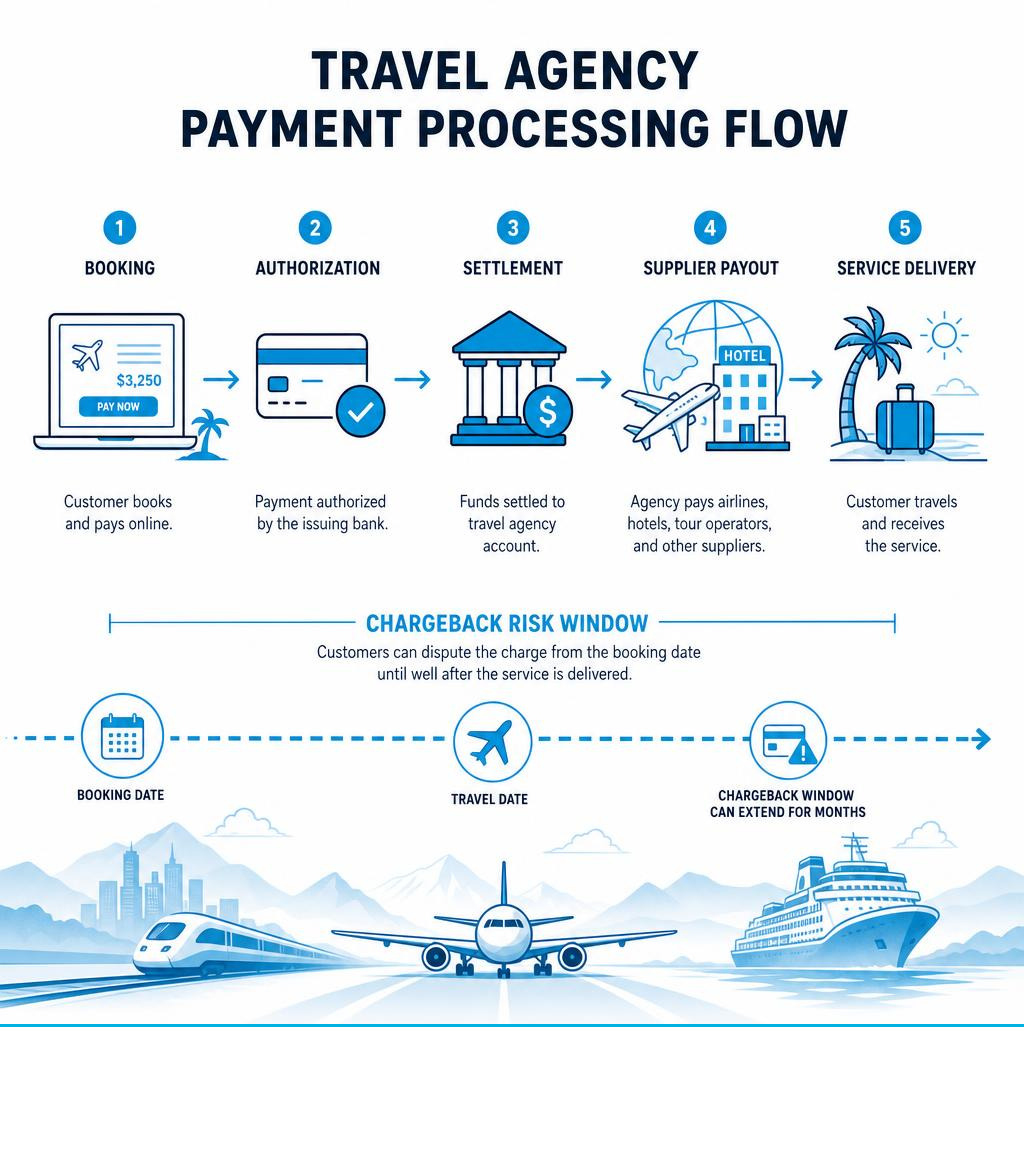
If your agency cannot cover these refunds immediately, customers will bypass you and file disputes directly with their issuing banks. This results in What Is A Credit Card Chargeback, where the processor must return the funds to the consumer. Because the window for a customer to file a chargeback can extend up to 120 days (or more) from the date of service delivery rather than the date of purchase, processors are exposed to long-term financial risk.
High Ticket Values and Transaction Volatility
Unlike standard retail operations where transactions average under $100, travel bookings regularly reach thousands of USD. High-value transactions naturally attract bad actors who look to exploit payment systems using stolen credit card data.
For agencies dealing in high-end sectors, such as Luxury Travel Payment Processing, a single fraudulent booking can result in a loss of $10,000 or more. This volatility is magnified when dealing with ultra-premium services. For instance, managing transactions in Private Jet Payment Processing requires specialized gateways that can handle five-figure sums securely.
When high transaction values are combined with unpredictable sales cycles, such as seasonal booking spikes during winter holidays or summer vacations, standard merchant accounts struggle to cope. If your daily processing volume suddenly jumps from $5,000 to $50,000 without prior high-risk underwriting, the processor’s risk software will flag the activity, assuming fraudulent behavior or card testing is taking place. This is a common trigger for post-approval shutdowns.
Common Challenges for Travel Agency Payment Processing Merchants
Operating a travel business means managing a highly complex financial environment. You are not just collecting payments; you are acting as a financial intermediary between travelers, airlines, hotels, tour operators, and global distribution systems (GDS).
To manage this complex workflow without losing revenue, agencies must implement a rigorous approach to risk, currency management, and operational workflows.
Managing Chargebacks and Friendly Fraud
Chargebacks are the single greatest threat to a travel agency’s merchant stability. In travel, chargebacks generally fall into three categories:
- True Fraud: A bad actor uses stolen credit card credentials to book flights or hotels, leaving the agency to pay the chargeback fee and lose the inventory.
- Friendly Fraud: A legitimate customer books a trip, experiences buyers’ remorse, or suffers an emergency, and files a chargeback claiming they “do not recognize the charge” or that the “service was not as described” instead of requesting a refund.
- Operational Disputes: Cancelled flights, weather delays, or poor hotel experiences where the customer holds the agency responsible, despite third-party execution failures.
To combat these threats, agencies must establish a proactive defense system. Implementing The Ultimate Guide To Chargeback Prevention is critical for keeping your dispute ratio below the industry-standard threshold of 1%.
Understanding the strict timelines associated with disputes is equally important. Knowing the Guide To Chargeback Time Limits and the specific Time Limit For Chargeback On Credit Card filings ensures you can submit compelling evidence in time to win representment cases.
Chargeback Prevention Checklist:
- Clear, transparent cancellation policies verified by active customer consent (checkboxes)
- Explicit transaction descriptors matching your agency’s legal name
- Real-time payment verification (CVV, AVS, and 3-D Secure 2.0)
- Immediate refund processing for legitimate cancellations to bypass formal disputes
Cross-Border Transactions and USD Settlement
Travel is inherently global. A travel agency based in Boston may regularly process bookings for a client traveling to Asia, utilizing suppliers based in multiple different countries. This creates two distinct challenges: high foreign transaction fees and currency conversion volatility.
When an international traveler books a trip, they expect to pay in their local currency, while your agency needs to settle the transaction in USD to maintain stable cash flow and pay local operational costs. If your payment gateway does not support multi-currency processing, your clients will face unexpected conversion fees, leading to abandoned shopping carts and declined transactions.
Furthermore, processing cross-border card payments without localized routing increases the likelihood of legitimate transactions being declined by issuing banks due to suspected fraud. For some highly international agencies, utilizing global banking connections or evaluating if Do I Need An Offshore Merchant Account is necessary to maintain high approval rates across diverse regions.
The Travel Booking Payment Workflow
The technical life cycle of a travel booking payment involves multiple parties and must be executed flawlessly to prevent cash flow gaps. Most traditional payment processors hold funds for 24 to 48 hours before making them available, which can create working capital strains when immediate supplier payouts are required.
To understand how money moves from the traveler’s card to your bank account, let’s examine the key phases of the transaction workflow:
Requirements for Travel Agency Payment Processing Merchant Account Approval
To run an efficient, secure, and profitable travel agency, you cannot rely on a generic payment gateway. Your gateway must integrate directly into your specialized booking software, CRM, or GDS systems to automate workflows and minimize manual entry errors.
When selecting a gateway, ensuring seamless integration is paramount. By Mastering Integrating Payment Gateway systems into platforms like Rezdy, FareHarbor, or custom APIs, you can automate confirmation emails, issue instant invoices, and manage split payments for group tours.
Security must also be integrated at the API level. Utilizing tokenization ensures that sensitive card data is replaced with unique digital identifiers, removing your systems from the scope of PCI DSS compliance and protecting client data from breaches.
Additionally, implementing advanced security layers like 3-D Secure (3DS) is vital. To understand how this technology balances security with user experience, read about What Is 3DS And How Does That Help Me to selectively apply verification to high-risk transactions without adding friction to trusted buyers.

Optimizing Travel Agency Payment Processing for Conversions
In the travel sector, checkout abandonment is exceptionally high. If a traveler encounters a clunky checkout process, lacks their preferred payment option, or experiences an unexpected transaction decline, they will take their business elsewhere.
To maximize conversion rates, your travel agency payment processing system must support modern, friction-free payment methods. While traditional credit and debit cards remain dominant, digital wallets like Apple Pay and Google Pay are critical for capturing mobile bookings, which now account for a massive share of the online travel market. Digital wallets also utilize built-in biometric authentication, which significantly reduces chargeback risk.
Additionally, integrating flexible payment options such as Buy Now, Pay Later (BNPL) or structured installment plans can help close high-ticket sales. For agencies offering recurring memberships, vacation clubs, or travel subscription boxes, having robust, automated billing logic is essential. Managing these recurring models requires specialized Subscription Payment Processing features to handle card-on-file updates and automated retries for declined transactions.
Automated Reconciliation and Virtual Cards
For travel agencies, collecting payment from the customer is only half the battle. Once you receive the funds, you must pay the various suppliers involved in the itinerary, including airlines, hotels, local tour guides, and transport services. Historically, this required manual invoicing, bank transfers, or corporate credit cards, leading to massive administrative overhead and reconciliation errors.
Modern travel payment platforms solve this using Single-Use Virtual Cards. When a customer books an itinerary, your system can automatically generate a unique, single-use virtual card to pay each supplier. These cards can be restricted to specific dollar amounts, active dates, and Merchant Category Codes (MCCs), virtually eliminating supplier fraud.
To fully optimize your B2B payment flows, focus on tools and workflows that reduce manual work without adding unnecessary risk:
- Use virtual cards for supplier payments, especially when paying hotels, tour operators, and other travel vendors.
- Support multi-currency payments when your agency regularly books international travel or pays overseas suppliers.
- Automate reconciliation so each booking, payment, refund, and supplier payout can be matched without spreadsheet-heavy tracking.
- Build controls around card limits, approved vendors, and payment timing to reduce fraud exposure.
- Choose payment infrastructure that supports both customer-facing transactions and back-office supplier payments, so your team can manage cash flow with fewer disconnected systems.
Why Travel Agency Payment Processing Face Account Shutdowns
Traditional banks and low-risk processors operate on thin margins and rely on automated underwriting. They are highly risk-averse and do not want to hold the financial liability of future-dated travel services.
Because of this, they often decline travel agencies during the initial application. Even worse, they may initially approve an account using automated systems, only to initiate a post-approval shutdown weeks later once your volume increases or your first chargeback occurs. This freezes your processing and holds your funds for up to 180 days, which can destroy a business’s cash flow.
Understanding Travel Agency Payment Processing Rates and Fees
When setting up your merchant account, understanding the cost structure is essential. Travel agency payment processing rates typically operate on an interchange-plus pricing model, which offers the most transparency by separating the card network’s base fee from the processor’s markup. Because travel is classified as high-risk, you may see slightly higher reserve requirements or per-transaction fees to mitigate the risk of future-dated fulfillment. However, partnering with a specialized provider ensures you receive competitive, sustainable rates without hidden fees.
Frequently Asked Questions About Travel Payments
Why do traditional banks decline travel merchant accounts?
Traditional banks and low-risk processors (like Stripe, PayPal, or Square) operate on thin margins and rely on automated underwriting. They are highly risk-averse and do not want to hold the financial liability of future-dated travel services.
Because of this, they often decline travel agencies during the initial application. Even worse, they may initially approve an account using automated systems, only to initiate a post-approval shutdown weeks later once your volume increases or your first chargeback occurs. This freezes your processing and holds your funds for up to 180 days, which can destroy a business’s cash flow.
How can travel agencies reduce chargeback rates?
Reducing chargebacks requires a combination of clear communication and technical tools:
- Transaction Descriptors: Ensure the billing name on the customer’s credit card statement matches your agency’s customer-facing name, not an obscure corporate holding company.
- Transparent Policies: Require customers to actively click “Agree” to your cancellation, refund, and modification policies before finalizing their booking.
- Pre-Dispute Networks: Use chargeback alert systems (like Verifi or Ethoca) that notify you before a dispute becomes an official chargeback, giving you a short window to issue a refund and protect your merchant standing.
- Verification Protocols: Implement CVV, AVS, and 3-D Secure 2.0 to verify card ownership during checkout.
What is the difference between a general and a specialized travel processor?
A general processor uses aggregate underwriting. They group your travel agency with low-risk retail businesses, making your account highly vulnerable to sudden shutdowns if your transaction patterns change.
A specialized high-risk processor conducts upfront, manual underwriting. They analyze your business model, booking windows, supplier agreements, and chargeback history before processing your first transaction. This results in customized processing limits, stable merchant accounts, and dedicated support from professionals who understand the seasonal nature of travel.
Top Travel Agency Payment Processing Providers
At Vector Payments, we specialize in providing stable, secure, and fully customized payment processing solutions for the travel industry. Whether you are operating a boutique agency in a major city, a luxury charter service, or a high-volume online travel agency, we understand the nuances of your business model.
We do not believe in automated, one-size-fits-all underwriting that leaves your business vulnerable to post-approval shutdowns. Our team conducts thorough upfront underwriting to ensure your merchant account is built for long-term stability.
By partnering with us, you gain access to:
- High-Risk Expertise: We specialize in securing accounts for travel agencies, tour operators, and cruise lines. If you operate in the cruise sector, we can help you Make Cruise Line Payment Processing Smooth or secure specialized Cruise Line Payment Processing Solutions Subpage accounts.
- Transparent Rates & Low-Risk Pricing: We leverage our relationships with over 25 acquiring banks to deliver highly competitive rates, proving the Advantages Vector Payments Major Processors offer over rigid, traditional financial institutions.
- 7-Day Dedicated Support: Travel never stops, and neither do we. We provide reliable, ongoing support to ensure your payment flows remain uninterrupted.
- Comprehensive Merchant Services: From online payment gateways to free physical terminals, we provide The Best Payment Processing For Small Business Owners in the travel space.
To get started, review our Opening A Merchant Account A Step By Step Guide to see how simple our onboarding process is. If you prefer working with a processor that offers personalized, local service, discover Why Your Local Credit Card Processor Is Better For You and how our years of expertise can benefit your business.
Don’t let unstable payment processing threaten your business growth. Learn more about the Travel Related Merchant Services Benefits we offer.
Ready to Secure Your Travel Agency Payment Processing?
At Vector Payments, we specialize in providing high-risk businesses with the stable, transparent, and secure payment processing solutions they need to grow. With interchange-plus pricing, advanced chargeback mitigation tools, and dedicated 7-day support, your agency stays ready for every booking.
Secure Your Travel Merchant Account