

Private Jet Payment Processing: High-Ticket Merchant Accounts for Charter Operators
A single frozen transaction can ground an entire charter flight, which is why securing reliable Private Jet Payment Processing is the most critical operational safeguard for your aviation business. When high-net-worth clients book a flight, they expect instant confirmation, but standard processors routinely decline or freeze accounts due to high ticket sizes and future service liability.
Key facts at a glance:
- Who needs it: On-demand charter operators, fractional ownership programs, jet card providers, brokerage firms, and aviation management companies
- Why it’s high-risk: Large per-transaction values, international clientele, and chargeback exposure from prepaid future flights
- What processors to avoid: General-purpose aggregators. They are not built for aviation transaction volumes
- What you actually need: A dedicated high-risk merchant account with high transaction limits, fraud filters, and multi-currency support
- Payment methods to support: Credit/debit cards, ACH, wire transfers, corporate cards, and jet card programs
If you’re running a charter business and your payment processor has ever frozen your funds, declined a booking mid-transaction, or shut down your account without warning, you’re not alone, and it’s not random. It’s a structural problem with how traditional processors categorize aviation.
The private jet industry moves fast. A client books a transatlantic flight on a Tuesday afternoon. Payment confirmation is expected within hours. There is no room for a processor that treats a $45,000 charter fee the same way it treats a $45 software subscription.
Over $2 billion in charter payments have been processed through aviation-specific platforms, which tells you two things: the volume is real, and the infrastructure to handle it properly already exists. The question is whether your business is plugged into the right part of it.
This guide walks you through everything, from why charter companies get flagged as high-risk, to which payment methods your high-net-worth clients actually expect, to how to set up a merchant account that won’t disappear on you six weeks after approval.
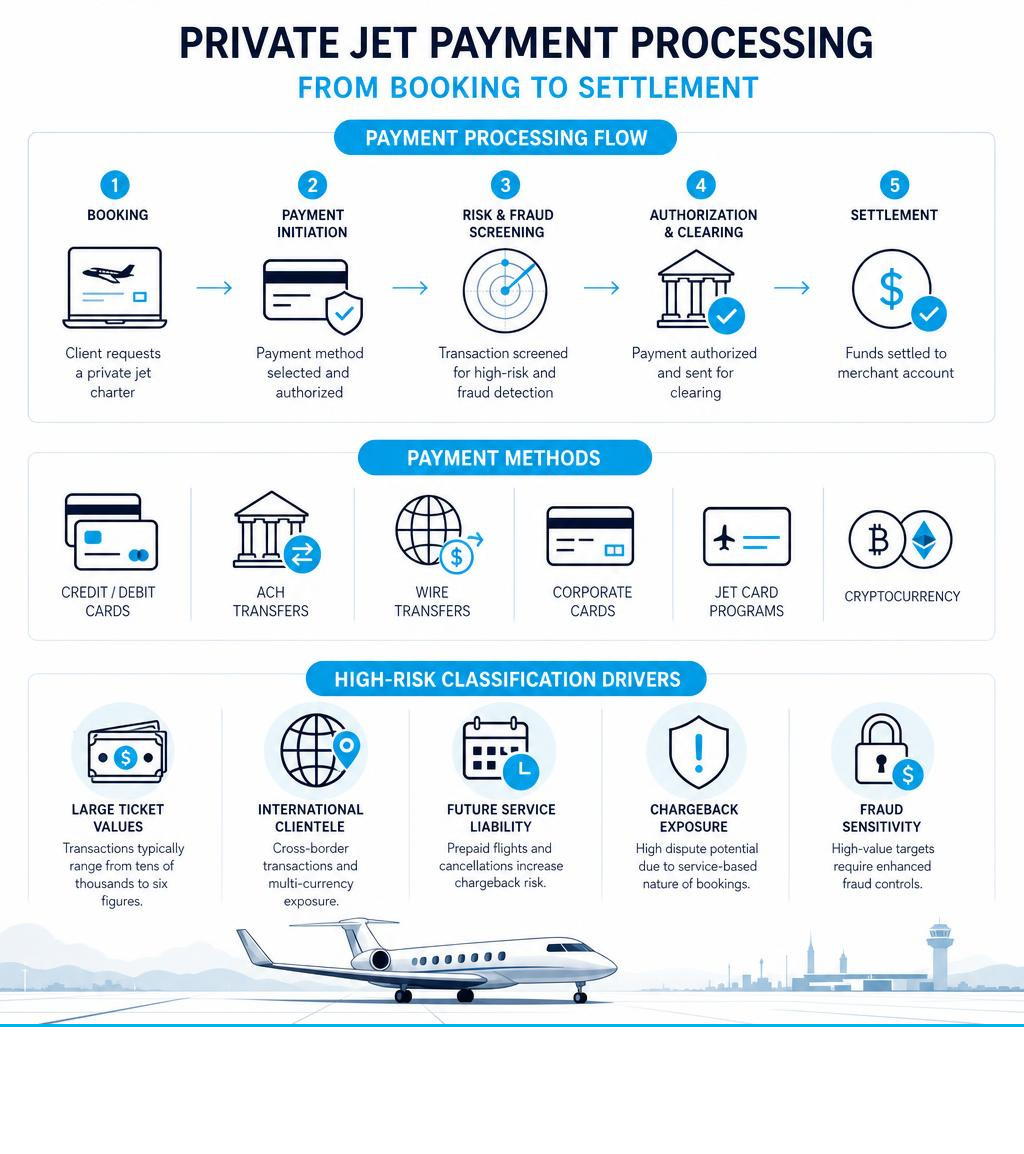
To run a successful private aviation operation, understanding the mechanics of payment acceptance is non-negotiable. At its core, accepting payments online or over the phone requires a merchant account. But high-ticket merchant account solutions are not a one-size-fits-all setup. Unlike a standard retail storefront, your transactions are massive, highly customized, and heavily regulated. Standard merchant accounts are built for low-risk, small-ticket retail. When you attempt to run a $50,000 booking through a standard account, the system flags it as highly unusual and immediately blocks the transaction.
For charter operators, brokers, and fractional ownership managers, establishing a dedicated specialized travel payment processing framework is essential. This specialized payment infrastructure handles everything from initial booking deposits and full flight charters to luxury concierge services (such as in-flight catering and ground transportation), jet maintenance fees, and membership program dues. Without a robust system designed for high-value transactions, your operations can stall, resulting in lost bookings and frustrated high-net-worth clients who expect a flawless, friction-free booking experience.
Why Private Jet Payment Processing Is Considered High-Risk
If you have tried opening a standard merchant account for your aviation business, you have likely run into the dreaded “high-risk” label. Payment processors classify industries as high-risk based on several specific criteria, and private jet charter services check nearly every box.
The primary reason is future service liability. When a client books a private flight, they often pay weeks or even months in advance. To an acquiring bank, this represents a massive liability. If your charter company experiences operational issues, mechanical failures, or scheduling conflicts and cannot fulfill the flight, the client is entitled to a refund. If the business cannot or does not issue that refund, the client will file a chargeback. Because the transaction values are so high, frequently ranging from $17,000 to over $100,000 per flight, the potential financial exposure for the bank is immense.
Additionally, the sheer size of the tickets makes standard processors nervous. A single transaction on a private jet charter can equal the entire monthly volume of a typical small business. Traditional payment aggregators are not designed to absorb this level of risk. If a fraudulent card is used to book a flight, the loss is substantial. To protect themselves, traditional financial institutions often outright reject aviation businesses or place restrictive holds on their funds. This is why obtaining specialized high-risk merchant accounts is the only viable path forward for serious aviation operators.
Why Private Jet Companies Face Account Shutdowns
Getting approved for a merchant account is only half the battle; keeping it active and operational is where many charter companies struggle. In our experience, the most common issue we see is the post-approval shutdown.
Many business owners apply for a merchant account through an aggregator, get automated approval within minutes, and assume they are good to go. However, once the business processes its first major transaction, such as a $35,000 flight booking, the aggregator’s risk department is alerted. Because the account was approved by an automated algorithm rather than a human underwriter, the sudden high-ticket transaction triggers a manual review. In most cases, this results in an immediate, permanent account termination and a hold on your funds for up to 180 days.
Furthermore, traditional accounts come with strict monthly volume caps and single-transaction limits. If your business experiences a sudden surge in demand, or if you secure a high-value multi-flight contract, exceeding your pre-approved processing limits can lead to declined transactions and account freezes. In a highly regulated space, navigating these operational hurdles requires working with a provider that understands high-risk regulated merchant services and can secure custom processing limits that match your actual sales volume.
Requirements for Private Jet Merchant Account Approval
To avoid sudden shutdowns and ensure long-term merchant stability, you must approach the application process with thorough preparation. Underwriters in the high-risk payment space look for transparency, financial health, and operational legitimacy.
Here are the practical steps to prepare a bulletproof application:
- Compile Comprehensive Underwriting Documentation: You must provide personal identification (such as a driver’s license or passport), your business EIN, and your articles of incorporation.
- Submit Detailed Bank Statements: Prepare at least 3 to 6 months of recent business bank statements. Underwriters want to see healthy cash reserves that prove your business can handle potential chargebacks or refund requests without going under.
- Provide Processing History: If you have processed payments in the past, provide at least 3 months of processing statements showing your transaction volumes, chargeback ratios, and refund rates.
- Ensure Website and Social Compliance: Your website must be fully functional and up-to-date. It must clearly display your terms and conditions, refund policies, privacy policies, and contact information. Underwriters will review your online presence to confirm you are an active, legitimate business.
- Demonstrate Regulatory Compliance: Be prepared to show that your operations comply with relevant aviation authorities, such as the FAA or local transportation security guidelines.
By presenting a complete, well-documented application upfront, you build trust with the underwriting bank, ensuring your account is approved with realistic limits and a stable foundation.
Private Jet Payment Processing Options to Support
High-net-worth individuals and corporate flight departments do not pay for services the way average consumers do. They expect absolute discretion, speed, and premium flexibility. If your checkout process is clunky, or if you cannot accept their preferred traditional payment method, the booking experience can quickly lose momentum.
To serve this clientele well, private jet operators need a payment setup that supports multiple secure payment options without creating unnecessary risk. While some clients prefer the security of traditional wire transfers, others want the convenience of using premium credit cards to earn high-value travel rewards. Providing dedicated luxury travel payment processing solutions means allowing your clients to choose a familiar, compliant way to settle their accounts.
Many operators ask: can you pay for a private jet with a credit card? The answer is yes, provided you have the right merchant account in place. Accepting high-limit corporate cards and luxury consumer cards is essential for securing last-minute bookings. When a client needs to fly immediately due to an urgent business meeting or a sudden change in plans, waiting for a bank wire to clear is not always practical. A secure, high-limit credit card transaction allows you to authorize the payment quickly, confirm the aircraft, and get your passengers in the air without delay.
Traditional and Alternative Payment Rails
Private aviation clients often need flexibility, but that does not mean every emerging payment option needs to be promoted. For most charter operators, the strongest payment mix focuses on proven, well-understood rails: credit and debit cards, ACH, wire transfers, corporate cards, and prepaid account structures.
A well-built payment environment should help operators:
- Authorize high-ticket card payments securely: High-limit card acceptance supports urgent bookings, concierge add-ons, and executive travel needs.
- Use wires for planned high-value trips: Wire transfers remain a practical option for large domestic and international bookings where timing allows.
- Support ACH for recurring billing: ACH or direct debit can work well for recurring memberships, management fees, and predictable billing cycles.
- Maintain clear settlement workflows: Operators should understand when funds authorize, capture, settle, and become available for operational use.
The goal is not to push clients toward unfamiliar payment methods. The goal is to create a stable, compliant, and convenient payment experience that matches how private aviation customers already prefer to pay.
Jet Cards and Prepaid Membership Programs
Another effective way to secure recurring revenue and build client loyalty is through jet cards and prepaid hour programs. These programs allow frequent flyers to prepay for a set number of flight hours at fixed or variable market rates, streamlining the booking process for future trips.
To manage these programs successfully, you need a payment processor that supports robust recurring billing and custom billing schedules. A payment gateway that integrates directly with your CRM or scheduling software allows your account managers to manually enter payments via a secure virtual terminal or automate monthly membership dues. This setup ensures that your frequent flyers can book a plane with a single phone call or text message, completely bypassing the need to run a card or send a wire for every single flight.
Understanding Private Jet Payment Processing Rates and Fees
Operating in the private aviation sector means managing complex financial logistics across multiple time zones and currencies. Because of the high-ticket nature of these transactions, understanding the rates and fees associated with your merchant account is critical to maintaining profitability. High-risk merchant accounts typically utilize interchange-plus pricing to ensure transparency, though flat-rate options are also available depending on your processing volume.
To help visualize how different payment methods compare for high-ticket aviation transactions, consider the following breakdown:
When dealing with international clients, utilizing travel related merchant services benefits is crucial. This includes features like multi-currency pricing, which allows clients to view and pay for their flights in their preferred local currency while your business receives the settlement in USD. This eliminates confusing exchange rate calculations and reduces foreign transaction fees, making the purchase experience seamless for your global clientele.
Common Challenges for Private Jet Merchants
Because private jet bookings involve such large sums of money, they are prime targets for sophisticated fraud schemes. Friendly fraud, identity theft, and unauthorized card usage can result in devastating financial losses if your business is not properly protected.
Understanding credit card chargeback prevention is the first step in protecting your revenue. A chargeback occurs when a client disputes a transaction with their card-issuing bank, demanding a forced reversal of the funds. In the aviation space, disputes often arise from last-minute flight cancellations, disagreements over weather-related delays, or fraudulent bookings made using stolen credentials.
To safeguard your merchant account and maintain a low chargeback ratio, you must implement a proactive strategy. We highly recommend reviewing chargeback prevention strategies to establish robust security protocols.
At a minimum, your payment gateway should utilize:
- 3D Secure (3DS) Technology: This adds an extra layer of verification for online card payments, requiring the cardholder to complete a two-factor authentication step with their bank before the payment is authorized. This simple step helps reduce fraud-related chargeback risk.
- Address Verification Service (AVS) & CVV Matching: Always require complete address and security code matching for every manual or online transaction.
- Advanced Identity Verification: For last-minute or high-value bookings, implement a rapid identity verification process to confirm the person booking the flight matches the name on the credit card.
- Clear, Detailed Contracts: Ensure every client signs a digital charter agreement that clearly outlines your cancellation, refund, and weather policies before the flight takes off.
By enforcing these strict compliance standards, you significantly reduce the risk of declined transactions, protect your hard-earned revenue, and keep your merchant account in excellent standing with your acquiring bank.
Ready to Elevate Your Private Jet Payment Processing?
Partnering with a specialized provider gives your business the high transaction limits, advanced fraud protection, and multi-currency capabilities required to scale globally. At Vector Payments, we specialize in stable, high-risk merchant accounts tailored for private aviation and luxury travel, backed by transparent rates, robust chargeback mitigation, and dedicated support 7 days a week.
Contact Vector Payments TodayFrequently Asked Questions About Private Jet Payments
Why do traditional processors decline private jet transactions?
Traditional payment processors and general-purpose aggregators are designed for low-value, high-volume retail transactions. Their automated risk algorithms are programmed to flag and decline transactions that exceed typical retail limits. Because a single private jet booking can easily exceed $25,000, these aggregators view the transaction as an extreme risk. Additionally, their systems are not built to handle the future service liability associated with prepaid travel, leading them to decline the transactions or freeze the merchant’s account to protect themselves from potential chargeback losses.
How can charter operators prevent post-approval account shutdowns?
The best way to prevent a post-approval shutdown is to avoid standard payment aggregators entirely and partner with a specialized high-risk merchant service provider. During the onboarding process, ensure your provider performs manual, transparent underwriting on your business. This means the underwriting bank fully understands your high ticket sizes, monthly volumes, and future flight liabilities before you process your first transaction. By establishing realistic volume caps and transaction limits upfront, you ensure your account remains stable and secure for the long haul.
What is the fastest traditional way to settle international charter payments?
For traditional fiat payments, wire transfers and multi-currency payment tools are often the most practical options for international charter bookings. A specialized merchant services provider can help operators route international payments efficiently, support multi-currency pricing, and reduce delays caused by banking cutoffs, weekends, or intermediary banks.