

Cruise Line Merchant Processing: High-Risk Payment Solutions

Operating a maritime business means facing constant financial exposure, where a single wave of chargebacks can instantly freeze your revenue and halt your operations; this is why securing reliable cruise line merchant processing is the single most critical step for any cruise operator.
What is cruise line merchant processing?
Cruise line merchant processing refers to the systems, accounts, and payment infrastructure that allow cruise operators to accept credit cards, debit cards, and alternative payments across online bookings, onboard point-of-sale systems, and port-side transactions.
Key facts at a glance:
- Cruise lines are classified as high-risk merchants by most banks and payment processors
- The primary reason: payments are collected months before service is delivered, creating high chargeback exposure
- The global cruise market is worth approximately $36 billion and growing at a 7% CAGR
- Approval rates for cruise merchants typically range from 0% to 85% (averaging 70–85% for specialized accounts) meaning a meaningful share of operators get declined outright
- Chargeback ratios above 1% trigger increased scrutiny and potential account termination
- Onboarding with a new payment processor typically takes 2–4 weeks in the cruise sector
- North America accounts for roughly 50% of global cruise revenue, making USD-denominated processing critical
Most mainstream processors, the ones that work fine for a standard retail store will either decline cruise merchants outright or approve them and shut them down later once they see the transaction patterns. That post-approval shutdown is where most operators get hurt.
This guide covers everything from why cruise lines get flagged as high-risk, to how to process payments at sea without internet, to what it actually takes to keep a merchant account open long-term.
Why Cruise Line Merchant Processing Payment Processing Is Considered High-Risk
To secure stable payment processing, we must first look at the merchant account from the perspective of an acquiring bank’s underwriting department. Underwriters are risk managers. When they evaluate a business, they are calculating the mathematical probability that the bank will be left holding the bag for unpaid customer disputes.
Under this lens, the maritime travel industry presents a perfect storm of risk vectors.
1. Delayed Service Delivery and Advance Bookings
The single largest factor in the high-risk designation is the massive window between the initial transaction and the actual delivery of the service.
When a passenger books a cruise, they typically pay a deposit or the full ticket price three to nine months before the ship ever leaves the port. During this entire pre-travel window, the cardholder has the right to file a dispute (chargeback) with their issuing bank. If a cruise operator experiences financial distress, a natural disaster, or a sudden regulatory halt during that time, thousands of passengers may file chargebacks simultaneously. The processor is contractually liable for those funds if the merchant cannot pay.
2. High Average Ticket Values
Unlike standard retail operations, a single transaction in the cruise industry frequently ranges from $1,500 to over $10,000. When high ticket sizes combine with delayed delivery, the financial exposure per transaction is exceptionally high. Compare this to other high-risk sectors we serve:
- In high-end smoke shops or vape retail, the average transaction is $50 to $150, and the product is delivered immediately.
- In med spas, high-ticket procedures (like a $3,000 treatment package) carry some delayed delivery risk, but the customer is local and the timeline is usually weeks, not months.
For a cruise line, a handful of disputed transactions can easily equate to tens of thousands of dollars in lost revenue and processing penalties.
3. Merchant Category Codes (MCC 4411)
Every business is assigned a four-digit Merchant Category Code (MCC) by their acquirer to classify their primary business activity. Cruise lines and steamships are assigned MCC 4411.
Card networks (Visa, Mastercard, Discover, and American Express) monitor MCC 4411 with extreme scrutiny. Because this code is flagged globally as high-risk, transactions are subjected to tighter fraud filters, which can lead to legitimate transactions being declined if the merchant’s payment gateway is not optimized.
To navigate these unique challenges, cruise operators must partner with a specialized high-risk payment processor that can structure dedicated merchant accounts designed to handle high ticket sizes and extended delivery windows without triggering false declines or sudden account terminations.
Common Challenges for Cruise Line Merchant Processing Merchants
Operating a cruise line means managing a business that is simultaneously an e-commerce booking engine, a luxury hotel, a collection of fine-dining restaurants, a retail hub, and an international tour operator.
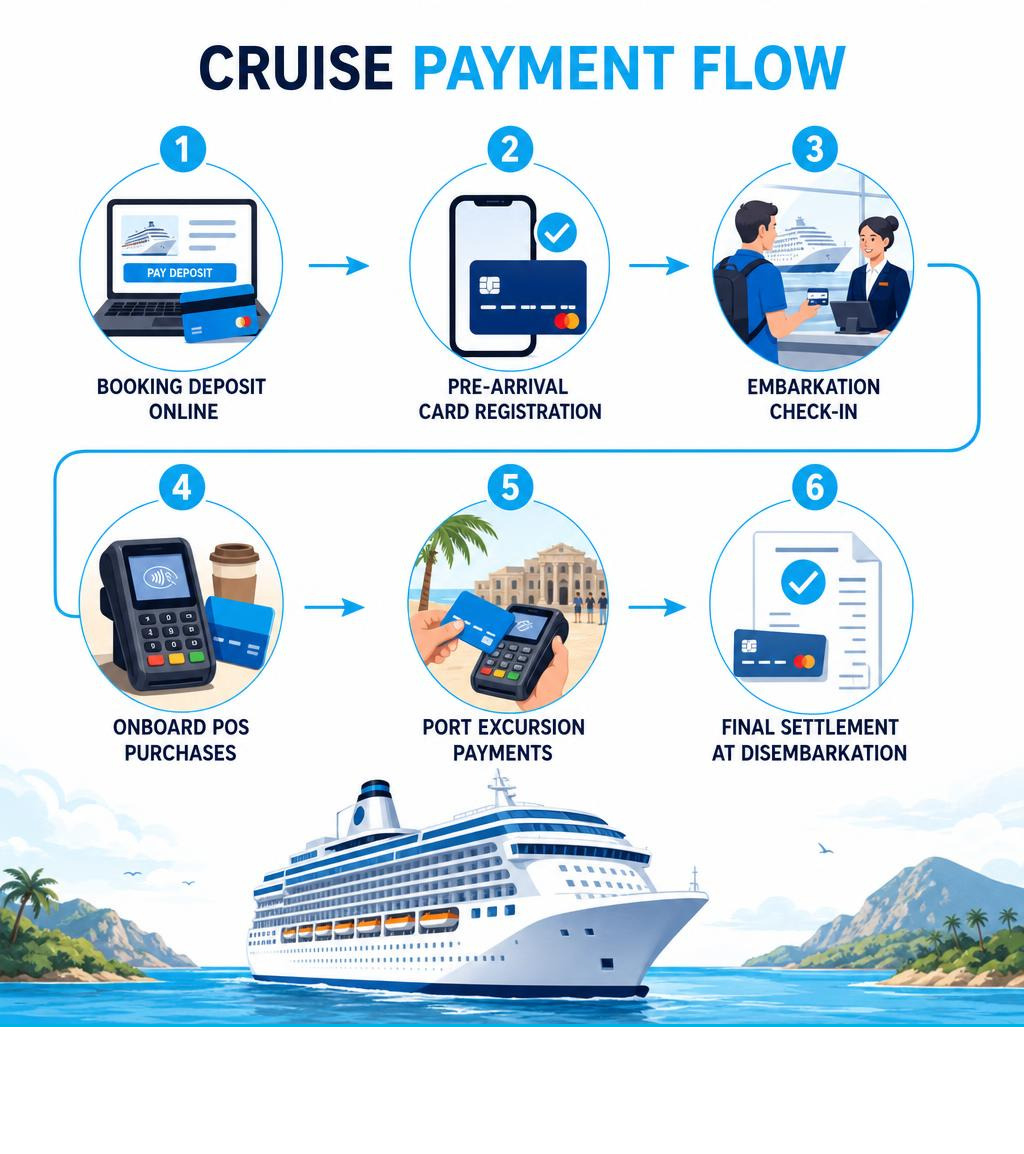
The typical cruise payment lifecycle moves from booking deposit online (with CNP fraud risk), through a 3-to-9-month holding period, to embarkation and onboard spending, and finally to disembarkation and potential post-cruise disputes.
The Chargeback Battleground
Because of the strict cancellation policies common in the maritime industry, customers who change their minds or experience personal emergencies often bypass the cruise line’s customer service and go straight to their bank to file a chargeback. Common dispute pretexts include:
- “Services not rendered” (often due to weather-related itinerary changes or missed ports of call).
- “Transaction not recognized” (frequently caused by confusing transaction descriptors on the passenger’s bank statement).
- “Unintended billing” (disputes over onboard charges made by family members or children).
If your chargeback ratio climbs above 1%, mainstream payment processors will place your account on a monitoring program, levy heavy fines, or implement a sudden post-approval shutdown, freezing your operating capital.
International and Cross-Border Complexities
Cruise lines cater to a global clientele. A single voyage might host passengers from thirty different countries, all paying with different local card brands and currencies.
When international transactions are routed through standard domestic payment gateways, they are frequently flagged as suspicious and declined. To prevent these declines, cruise operators require specialized multi-currency routing and dynamic currency conversion (DCC) to settle transactions in the passenger’s local currency while protecting the cruise line’s bottom line in USD.
To navigate these travel-specific hurdles, establishing a dedicated travel payment processing merchant account pipeline is essential to ensure transactions are routed efficiently without triggering false fraud alerts.
Underwriting Reserves
Because of the inherent risks of MCC 4411, processors will often impose a rolling reserve. This means the processor holds a percentage of your daily gross card sales (typically 5% to 10%) in a non-interest-bearing escrow account for a set period (usually 90 to 180 days) to cover potential chargeback liabilities.
For high-volume cruise lines, managing this cash flow restriction requires a processing partner who offers flexible underwriting and can adjust reserve requirements based on processing history and financial stability. Typically, merchants with strong processing history can get approved with no reserve requirements at all.
Requirements for Cruise Line Merchant Processing Merchant Account Approval
To secure approval for a high-risk merchant account, operators must meet strict underwriting criteria across all payment channels and touchpoints throughout the passenger journey.
1. Online Bookings and Reservations
The journey begins on land. Your e-commerce gateway must handle high-value transactions, support recurring billing or installment plans for deposit payments, and integrate directly with your central reservation system (CRS). Because these are Card-Not-Present (CNP) transactions, they require robust security protocols like 3D Secure (3DS) to verify the cardholder’s identity before the transaction is finalized.
2. Onboard Point of Sale (POS) Systems
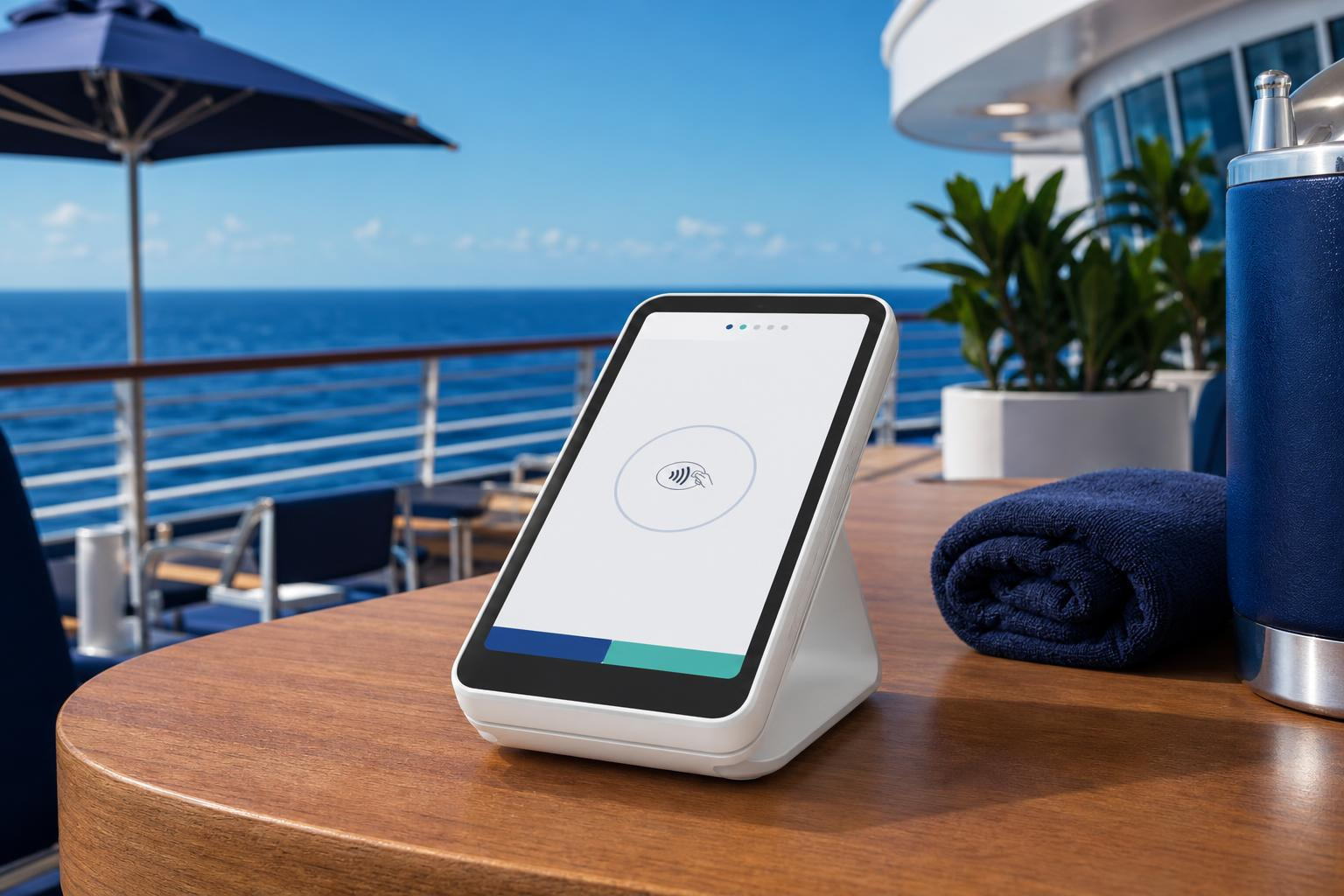
Once onboard, the ship operates as a closed-loop economy. Passengers typically register a credit card at embarkation and use a wearable device, room key, or mobile app to make purchases at restaurants, bars, spas, and retail shops. These transactions must be batched, authorized, and settled continuously.
For operators offering ultra-premium voyages, integrating luxury travel payment processing solutions ensures that high-limit cards are authorized smoothly without interrupting the guest experience.
3. Mobile and Port-Side Transactions
When the ship docks, the payment needs follow the passengers ashore. Whether selling shore excursions on the pier, operating pop-up retail boutiques, or managing shuttle services, crew members require rugged, wireless, mobile POS terminals that can process transactions securely in real-time or offline.
Payment Channel Comparison
Understanding Cruise Line Merchant Processing Payment Processing Rates and Fees
Operating a payment network on an ocean-going vessel introduces a challenge that land-based retail stores never have to face: unreliable internet connectivity.
Even with modern satellite systems, cruise ships regularly pass through dead zones where satellite signals drop. If your POS terminals rely on a constant internet connection to authorize transactions, your onboard commerce will grind to a halt.
Understanding the rates and fees associated with high-risk processing is crucial. Because of the unique maritime environment, processors structure fees based on transaction volume, chargeback history, and the specific integration of offline capabilities.
Store-and-Forward (Offline Transaction Capture)
To maintain maritime payment stability, cruise lines utilize specialized Store-and-Forward technology. When a card is tapped onboard, it undergoes offline validation and secure local encryption before being stored in the POS cache. Once the satellite connection is restored, the gateway upload occurs, leading to real-time authorization.
Tokenization and P2PE Security
Storing credit card data locally on a ship is a major security risk and a violation of PCI DSS standards if not handled correctly. PCI DSS requirements are maintained by the PCI Security Standards Council, and cruise operators should treat those standards as the baseline for payment security across online booking engines, onboard POS systems, and port-side terminals.
To solve this, we implement Point-to-Point Encryption (P2PE) and Tokenization.
- P2PE: The moment a card is read by the EMV terminal, the sensitive data is instantly encrypted. The POS software and the ship’s onboard servers never see or store plain-text cardholder data.
- Tokenization: The encrypted data is exchanged for a secure token, which is a unique alphanumeric identifier. This token is used for all subsequent onboard purchases, room charges, and post-cruise settlements, keeping the actual card data protected from potential breaches.
Risk Mitigation Strategies for Cruise Line Merchant Processing
To protect your merchant account from sudden shutdowns, you must implement a proactive risk management protocol.
- Implement 3D Secure (3DS): This protocol adds an extra verification step for online bookings, shifting the chargeback liability from the cruise operator to the card-issuing bank for fraudulent transactions.
- Utilize Chargeback Alerts: By integrating systems like Verifi and Ethoca, we receive real-time alerts when a customer disputes a charge. This gives us a 24-to-72-hour window to issue a refund and resolve the issue before it escalates into a formal chargeback, keeping our chargeback ratio well below the critical 1% threshold.
- Optimize Transaction Descriptors: Ensure that the name appearing on the passenger’s credit card statement matches what they expect to see, such as
CRUISE-LINE-RESERVATIONSrather than an obscure corporate holding name. This simple step eliminates a massive percentage of unrecognized transaction disputes. - Rigorous KYC and Documentation: During the underwriting phase, merchants must provide comprehensive Know Your Customer (KYB/KYC) documentation, including corporate registration, previous processing statements, and proof of passenger safety certifications.
To explore how structured risk mitigation can improve your overall business health, review our guide on high-risk travel merchant services benefits.
Why Cruise Line Merchant Processing Face Account Shutdowns
The absolute worst-case scenario for any high-risk business is a post-approval shutdown.
This occurs when a standard, low-risk payment processor approves a high-risk merchant (often using automated underwriting systems) and then abruptly terminates the account weeks or months later after realizing the high ticket sizes and delayed delivery patterns. When this happens, the processor typically freezes the merchant’s funds for up to 180 days to cover potential chargebacks, leaving the business without the cash flow needed to operate.
The shutdown sequence typically begins when a standard processor approves an account, followed by the first high-ticket booking being processed, which triggers a system flag and results in the account being frozen and funds held for up to 180 days.
Whether you run a luxury cruise line, a high-volume smoke shop, a busy vape e-commerce store, or a high-ticket med spa, the key to long-term merchant stability is working with a partner who understands specialized industries from day one.
We don’t rely on automated, one-size-fits-all underwriting. We build custom relationships with specialized acquiring banks that are fully aware of your business model, booking cycles, and transaction volumes before the first card is ever run.
To find out how to transition your operations to a secure, dedicated framework, visit our cruise line payment processing solutions page.
Choosing a Partner for Cruise Line Merchant Processing
When selecting a payment processing partner for your cruise line, look for these three non-negotiables:
- Transparent Rates: High-risk processing shouldn’t mean predatory pricing. Look for interchange-plus pricing models where you know exactly what the card brands charge and what the processor’s margin is.
- 7-Day Support: Cruise ships operate 24/7/365 across different time zones. If a payment gateway goes down on a Saturday night in the middle of the Caribbean, you cannot afford to wait until Monday morning for a customer support representative to answer your call.
- High-Risk Travel Expertise: Your processor must have deep relationships with acquiring banks that specialize in travel, tourism, and maritime commerce.
At Vector Payments, we specialize in providing stable, secure, and highly scalable merchant accounts tailored for high-risk industries. We combine low-risk pricing structures with the robust, specialized underwriting required to keep your cruise operations running smoothly on land and at sea.
Ready to Secure Your Cruise Line Payment Processing?
Ready to secure your payment infrastructure? Let’s discuss how we can get your cruise line properly underwritten, placed with the right banking partner, and supported for the long term.
Top Cruise Line Merchant Processing Payment Processing Providers
When evaluating the top cruise line merchant processing payment processing providers, operators must look beyond standard aggregators and partner with specialized high-risk acquirers like Vector Payments that offer dedicated underwriting, multi-currency support, and offline-capable gateways.
Frequently Asked Questions about Cruise Line Payments
Why is cruise line merchant processing considered high-risk?
Cruise lines are classified as high-risk primarily because of delayed service delivery. Customers book and pay for their trips months in advance, creating a long window for potential chargebacks. Additionally, high average ticket values (often thousands of dollars) and complex international transactions increase the financial exposure for the acquiring bank. This risk profile requires specialized underwriting, similar to other heavily regulated or high-ticket high-risk sectors like smoke shops, vape retailers, and med spas.
Can cruise lines process payments onboard without internet access?
Yes. Using specialized Store-and-Forward technology, onboard EMV terminals can securely capture, encrypt, and store transaction details locally while the ship is in a low-connectivity or offline environment. Once the ship’s satellite connection is restored, the system automatically transmits the batched transactions to the payment gateway for authorization, preventing declined transactions and keeping onboard operations moving.
How can cruise operators prevent post-approval merchant account shutdowns?
The best way to prevent a sudden account shutdown is to avoid using standard, low-risk aggregation processors (who often freeze accounts once they notice high-ticket, delayed-delivery travel transactions). Instead, work with a dedicated high-risk processor who specializes in maritime travel. By establishing an account backed by customized underwriting, utilizing chargeback alert systems, and maintaining strict PCI compliance, you can ensure long-term processing stability.
Conclusion
Navigating the waters of cruise line merchant processing requires more than just a standard payment gateway. It demands a highly secure, offline-capable, multi-currency payment infrastructure backed by a processor that understands the unique risk profile of the maritime travel industry.
By prioritizing regulatory compliance, implementing robust risk mitigation tools like tokenization and chargeback alerts, and choosing a dedicated, transparent processing partner, you can protect your cash flow, eliminate false declines, and deliver a flawless payment experience for your guests from booking to disembarkation.
Don’t leave your transaction stability to chance. Contact us today, and let’s work together to apply for cruise line payment processing.