
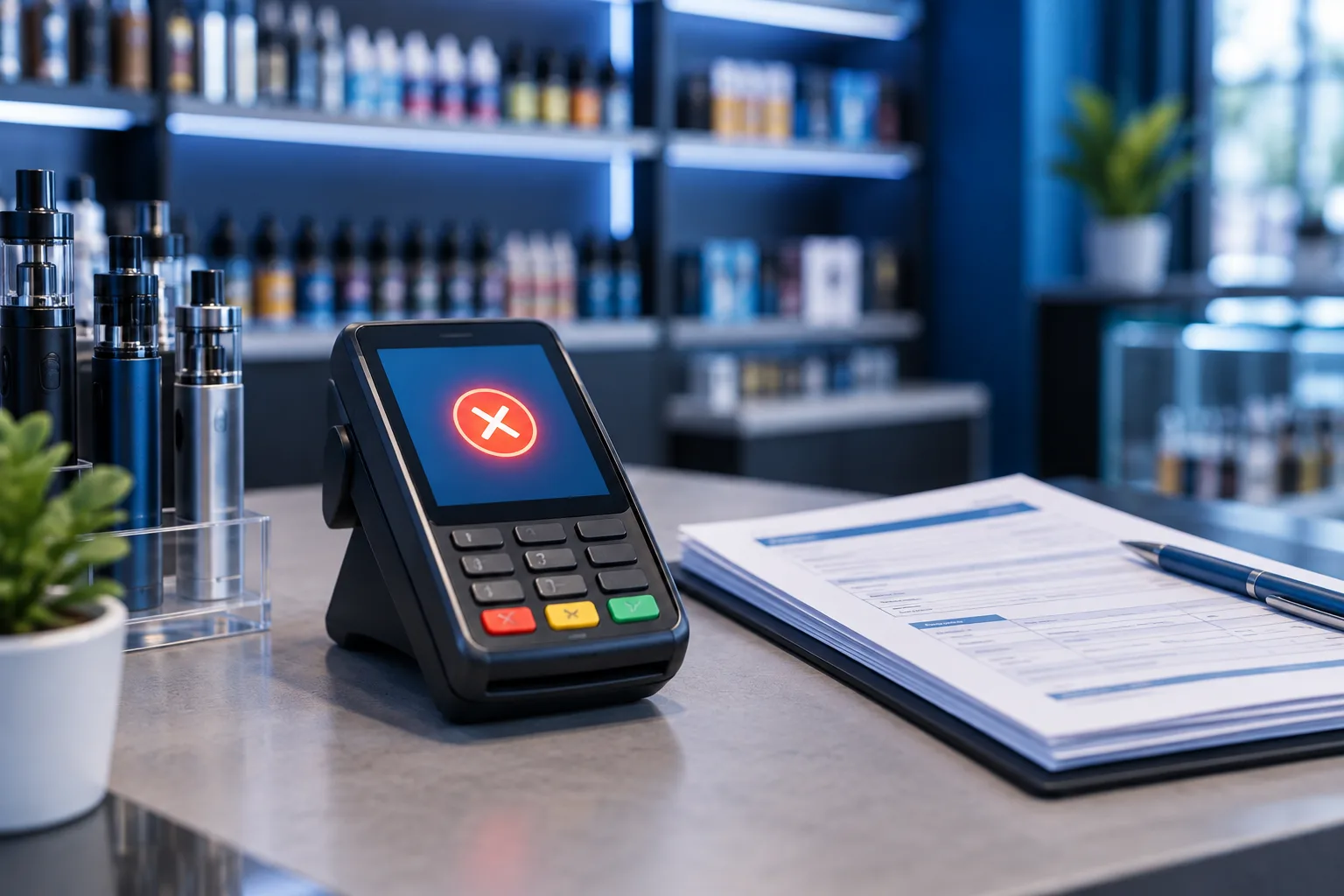
Why Was My Vape Merchant Account Application Rejected?
A vape merchant account application gets turned down for reasons that have almost nothing to do with whether your business is legitimate. Most rejections trace back to a handful of specific, fixable issues: an undisclosed product mix, a missing card network registration, or a shadow flag from a previous account that most owners never even know exists. If you just got a decline letter and no real explanation, this breaks down what actually happened and what to check first before you apply for a new vape merchant account.
For the full picture of how vape merchant accounts get approved and stay stable long term, see Vape Payment Processing at Vector Payments.
Quick Answer: Why Do Vape Merchant Account Applications Get Rejected?
The most common reasons are an undisclosed or mismatched product mix (nicotine, CBD, and flavored disposables often need to be flagged separately), a prior appearance on Visa’s or Mastercard’s terminated-merchant database, missing PACT Act registration or age-verification proof, or a processing history with high chargebacks. Most of these are fixable once you know which one applies to you.
What Are the Most Common Reasons a Vape Merchant Account Gets Rejected?
1. Your product mix wasn’t fully disclosed
Nicotine e-liquids, disposable vapes, CBD vape cartridges, and flavored pod systems each carry a different regulatory profile, and underwriters expect every product line disclosed upfront. A shop that lists itself as a general “vape retailer” without breaking out that it also sells CBD vape oil, for example, can get flagged for an undisclosed product category, since CBD and nicotine products fall under separate regulatory frameworks and some banks require separate merchant accounts for each. This is one of the most common reasons an otherwise clean application gets sent back for more information or rejected outright.
2. You’re on a card network’s terminated-merchant file
Visa and Mastercard each maintain a global database of merchants an acquirer has previously terminated for rule violations, fraud, or excessive chargebacks, known as Visa’s Merchant Screening Service (VMSS) and Mastercard’s Alert to Control High-Risk Merchants (MATCH). Every acquirer is required to screen new applicants against these databases before approval, and a listing under a business name, EIN, or even a principal owner’s name from a previous account, including one at a different business, can trigger an automatic decline. Listings stay active for five years, and outside of cases involving an error, identity theft, or a resolved PCI-DSS compliance code, only the acquirer that filed the original listing can request a correction or removal.
3. Age-verification and PACT Act compliance weren’t documented
Federal law requires any business that sells electronic nicotine delivery systems (ENDS), which includes vapes, e-cigarettes, and vaping components, to register under the PACT Act and verify the age of every customer at the point of sale, whether online or in-store. Underwriters specifically look for proof of age-gating technology at checkout and, for online or shipped sales, documentation that a business is registered and compliant with these delivery and verification rules. Missing this proof is a common, easily overlooked reason applications stall or get declined.
4. Your business was classified under the wrong Merchant Category Code
Card networks assign a Merchant Category Code (MCC) to every business based on what it actually sells, and vape and tobacco-adjacent retailers are expected to be classified accordingly rather than as general retail. Applying through a standard processor without the correct high-risk classification for a vape merchant account, or one that doesn’t support vape merchants at all, is a frequent cause of same-day auto-declines before a human underwriter ever reviews the file.
5. Your processing history shows elevated chargeback or fraud activity
If you’ve processed payments before, whether through a previous merchant account or a payment aggregator like Square or PayPal, that processing history follows you. A chargeback ratio that ran high at a prior account, even one you’ve since closed, is one of the most common reasons a new high-risk underwriter asks for extra documentation or declines an application outright.
How Do You Find Out If You’re on a Terminated-Merchant List?
You typically can’t check Visa’s or Mastercard’s databases directly. In most cases, you find out because an application gets declined and the processor cites a TMF or MATCH hit as the reason, or a new underwriter tells you directly during the review. If that happens, ask your prospective processor which network flagged the listing and under which of the standard reason codes, since that determines whether the issue is fixable, disputable, or something you’ll need to work around with a processor built for higher-risk histories.
Vape Merchant Account Rejection: From Application to Outcome


Fraud
Compliance

What Should You Do After a Rejection?
- Ask the processor for the specific decline reason in writing, not just a generic denial
- Confirm whether the decline references a TMF/MATCH listing versus a standard underwriting judgment call
- Gather PACT Act registration confirmation and proof of age-verification technology
- Document your full product mix, including any CBD, hemp, or flavored disposable lines, before reapplying
- Pull your own processing history and chargeback ratio from your most recent account so there are no surprises
Rejection Reason vs. What It Actually Means
Rejected Once Doesn’t Mean Rejected Everywhere
Ready to Find Out Exactly Why Your Vape Merchant Account Was Declined?
Vector Payments reviews rejected applications directly, identifies which specific issue caused the decline, and builds a vape merchant account around your actual risk profile instead of guessing.
Learn more about Vape Payment Processing at Vector Payments →
FAQs About Vape Merchant Account Rejections
Can I just reapply with a different processor after getting rejected?
You can, but if the rejection was caused by a terminated-merchant listing or a documentation gap, reapplying without fixing the underlying issue usually leads to the same result. Identifying the actual reason first saves time.
How long does a TMF or MATCH listing stay active?
Both Visa’s and Mastercard’s terminated-merchant databases keep listings active for five years, and only the acquirer that originally filed the listing can request a correction or removal.
Does selling CBD vape products alongside nicotine products cause automatic rejection?
Not automatically, but it needs to be disclosed. CBD and nicotine products fall under different regulatory frameworks, and some banks require separate merchant accounts for each. Failing to disclose the full mix upfront is what typically causes the problem. Vector Payments have solutions for these products as well!
Do I need to be PACT Act registered even if I only sell in-store, not online?
The PACT Act’s registration and age-verification requirements apply broadly to businesses that sell electronic nicotine delivery systems, including in-store retailers. Processors underwriting a vape account will generally expect to see this documentation regardless of your sales channel.
Sources: ATF Alcohol and Tobacco Division (atf.gov); Chargeback Gurus, “The MATCH List Explained” (chargebackgurus.com); Visa Merchant Screening Service, Visa Developer Center (developer.visa.com); Visa Merchant Data Standards Manual (usa.visa.com). As of September 30, 2026.