
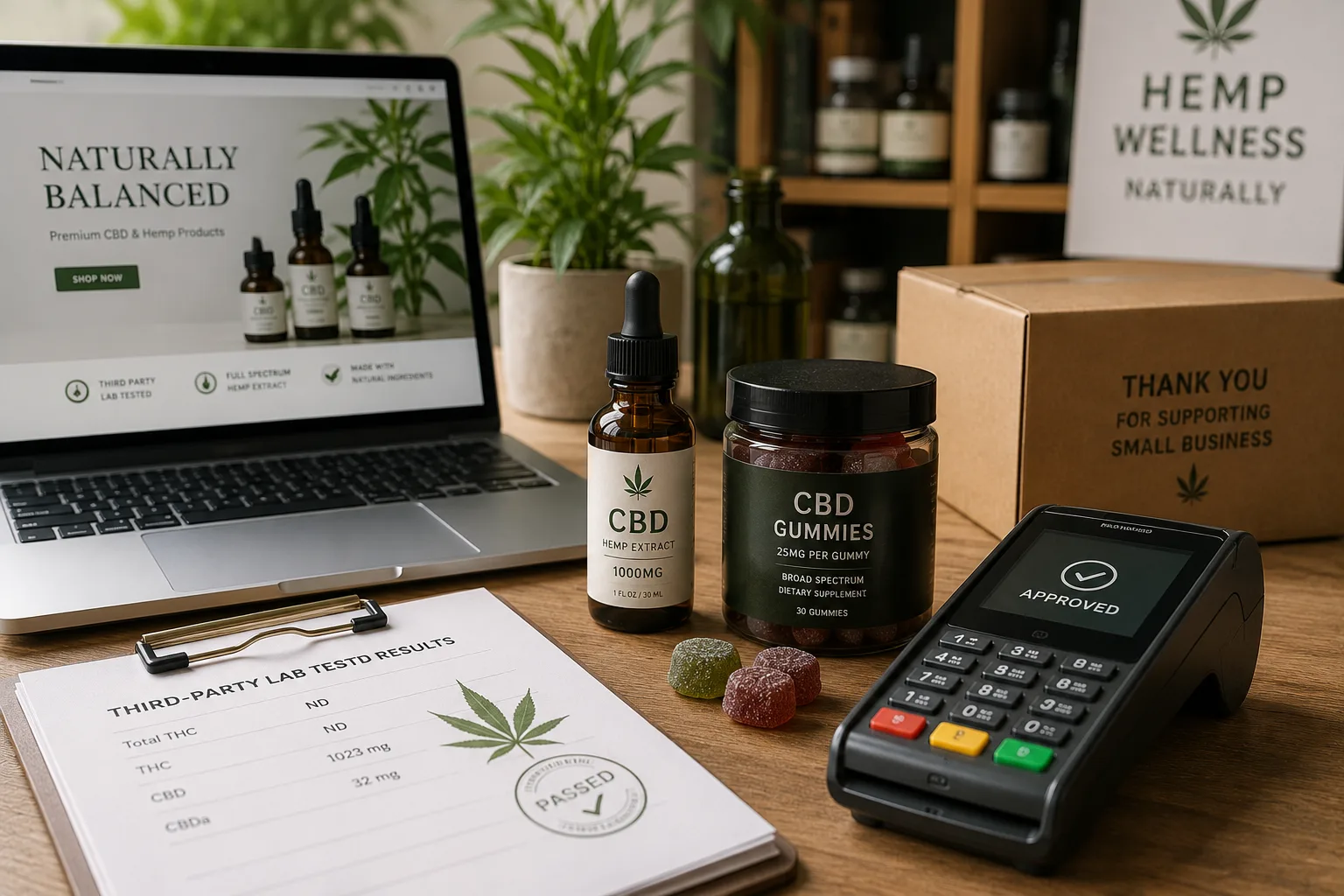
Payment processing tends to get treated as a formality once a product is legal to sell. For CBD and hemp brands, that assumption is exactly where new founders get blindsided: legal status and processor risk appetite are two very different things, and most mainstream processors were never built to underwrite this category in the first place.
This guide is for CBD and hemp brand founders setting up merchant processing for the first time, especially those relying on subscribe-and-save revenue.
Priya spent nearly a decade in corporate wellness marketing before she finally launched the brand she’d been sketching out on napkins for years: a small-batch line of hemp tinctures and gummies, anchored by a monthly subscribe-and-save program that now accounts for most of her revenue. She bootstrapped the whole thing (inventory, packaging, a lean ecommerce site), and for the first few months, the biggest challenge was just getting noticed. Then a founder in a CBD industry Facebook group posted that her account had been shut down overnight, funds held for months, subscribers left uncharged and unfulfilled. Priya read the thread twice.
She’d assumed that because hemp-derived CBD is federally legal (as long as THC stays under 0.3%, per the 2018 Farm Bill), payment processing would be a formality. It isn’t. Legal status and processor risk appetite are two very different things, and most of the processors small ecommerce founders default to were never built to underwrite a category like hers in the first place.
That gap is exactly where new CBD and hemp founders get blindsided. Not because they’re doing anything wrong, but because they picked a processor built for low-risk sales and didn’t know to ask the right questions upfront.
Why CBD and Hemp Businesses Are Considered High-Risk (Even Though It’s Legal)
Federal legality under the 2018 Farm Bill covers hemp with less than 0.3% THC, but banks, card networks, and generic online processors make their own risk decisions independent of that legal framework. Most mainstream processors explicitly prohibit CBD and hemp products in their terms of service, regardless of compliance, because the category still carries baggage they’d rather avoid.
Regulatory ambiguity. Regulations vary state by state, and the FDA’s stance on ingestible CBD products continues to evolve, which makes the category feel unsettled even where it’s legal.
Reputational sensitivity for banks. Banks are sensitive to reputational risk tied to anything resembling cannabis, fair or not.
Elevated chargeback rates. Ecommerce supplement brands generally see higher rates of chargebacks and fraud than typical retail, and subscription models add another layer since customers sometimes dispute charges they forgot they’d agreed to rather than contacting the merchant first.
None of this means CBD is unbankable. It means it needs a processor that actually specializes in high-risk categories and underwrites accordingly, rather than one that will approve you today and shut you down the moment your volume attracts attention.
How to Choose a Payment Processor When You’re Starting a CBD or Hemp Brand
Confirm They Actually Accept CBD and Hemp Merchants
Don’t take a generic signup form at face value. Many mainstream and generic online processors will let a CBD brand start processing, then flag and freeze the account weeks or months later once volume grows. Look for a processor that lists CBD and hemp as an accepted, understood category, not one you’re squeezing into a general “supplements” box and hoping no one notices.
Know What Documentation and Lab Testing You’ll Need
Legitimate high-risk underwriting for CBD typically asks for a certificate of analysis (COA) or lab testing confirming THC content is under 0.3%, a full ingredient list for each product, and a review of your website copy to make sure you’re not making medical or health claims that regulators would flag. Having these ready before you apply speeds up approval and signals that you run a compliant, serious operation.
Make Sure Subscription/Recurring Billing Is Fully Supported
If subscribe-and-save is core to your revenue, your processor needs to genuinely support recurring billing, not just tolerate it. That means handling failed renewal payments gracefully, giving you visibility into upcoming charges, and having a process for subscription cancellation disputes, which are one of the most common chargeback sources for subscription supplement brands.
Ask What Happens If Your Funds Get Held or Frozen
This is the question new founders skip and later regret. Ask directly: under what circumstances would funds be held, how long would a review take, and what’s the appeal process? For a subscription business, a frozen account doesn’t just pause incoming revenue: it can leave you unable to fulfill orders customers already paid for, damaging trust you’ve spent months building.
Compare Pricing Transparency
High-risk processing sometimes carries a reputation for hidden fees. A bootstrapped founder needs to know exactly what she’s paying, so look for transparent, predictable pricing structures, and ask whether options like dual pricing or surcharging are available to help offset processing costs without surprising your customers.
Generic Processor vs. Vector Payments for CBD and Hemp
| Factor | Generic / Mainstream Processor | Vector Payments High-Risk CBD/Hemp Account |
|---|---|---|
| Acceptance of CBD merchants | Often prohibited outright in terms of service | Understood and accepted category with dedicated high-risk expertise |
| Documentation scrutiny | Minimal upfront, but risk of retroactive review and shutdown | Clear upfront requirements (COAs, KYC documents, site compliance) |
| Risk of frozen funds/shutdown | Higher: accounts can be flagged and frozen with little warning | Lower: built for long-term account stability from day one |
| Subscription billing support | Basic recurring billing, limited dispute handling | Full recurring billing support with proactive dispute management |
| Pricing transparency | Can include hidden or escalating fees over time | Transparent pricing, including dual pricing and surcharging options |
| Support when issues arise | Limited, slow, or automated support channels | Real customer support familiar with high-risk merchant needs |
Why CBD and Hemp Founders Choose Vector Payments
Vector Payments works with CBD and hemp brands as a core part of its high-risk payment processing business, not as an afterthought.
Fast, realistic approvals. Built around the documentation your category actually requires.
Transparent pricing. Including dual pricing and wholesale pricing options, with no surprise fee creep.
Recurring billing built for subscribe-and-save models. Designed to reduce failed-renewal and cancellation-related chargebacks.
Stable, long-term merchant accounts. Not short-term approvals that get pulled later, plus modern POS and omnichannel tools if you ever expand beyond ecommerce.
Real US-based support. From a team that understands high-risk industries.
Frequently Asked Questions
Is CBD legal to sell online?
Hemp-derived CBD with less than 0.3% THC is federally legal under the 2018 Farm Bill. However, legality doesn’t guarantee a payment processor will accept your business, since many mainstream processors prohibit CBD regardless of its legal status, which is why choosing a high-risk specialist matters.
Why do CBD businesses get flagged as high-risk if the product is legal?
Risk classification is separate from legality. It reflects regulatory ambiguity across states, the FDA’s evolving position on ingestible CBD, reputational sensitivity for banks, and the higher chargeback and fraud rates common to ecommerce supplement brands. Adjacent categories like THCa and Delta 8 add to that uncertainty, since both may face additional regulatory scrutiny as soon as November 2026, which is one more reason processors treat the broader hemp-derived category with caution.
What documentation do I need to get approved for CBD payment processing?
Most high-risk underwriters ask for a certificate of analysis (COA) or lab testing showing THC content, a complete product ingredient list, and a website review to confirm you’re not making unsupported medical claims.
What happens to my subscription revenue if my account gets frozen?
If funds are held or an account is shut down, a subscription business can lose access to revenue it’s already promised to fulfill, meaning customers who paid for upcoming shipments may not receive them, damaging trust and creating disputes. Choosing a processor built for long-term stability helps prevent this scenario.
Does Vector Payments support recurring or subscribe-and-save billing?
Yes. Vector Payments supports recurring billing designed for subscription models, helping reduce chargebacks tied to failed renewals and cancellation disputes while keeping your account stable long-term.
Ready to Set Up a Stable CBD or Hemp Merchant Account?
Don’t wait for a frozen account to find out your processor never really understood your business. Talk to Vector Payments about a merchant account built specifically for CBD and hemp brands. Call 888-237-1754 to get started.