

What happens when your peptide payment processor freezes your funds is one of the most disruptive scenarios a business in this space can face. If you are selling peptides and relying on the wrong payment processor, a sudden funding hold can stop your cash flow overnight and put your entire operation at risk.
This is not a rare situation. It is a predictable outcome when peptide businesses use processors that are not built for or understand how to handle high-risk industries.
Key Summary
- Funding freezes typically happen after a risk review or account flag
- Peptide Payment processors may hold funds for weeks or potentially up to 6 months
- Peptide businesses are more likely to be flagged due to industry classification
- Mainstream processors do not underwrite high-risk businesses properly
- High-risk merchant accounts prevent unexpected holds and disruptions
Why Payment Processors Freeze Funds
When a payment processor freezes your funds, it is usually tied to risk management. Platforms like Stripe, Square, and PayPal are designed to protect themselves and their banking partners, not your business.
Peptide businesses often trigger risk alerts due to product type, compliance concerns, or transaction patterns. Without proper peptide payment processing, these alerts can quickly escalate into account restrictions or fund holds.
Processors do not need to prove wrongdoing. If your business falls outside their acceptable risk profile, they can take action immediately.
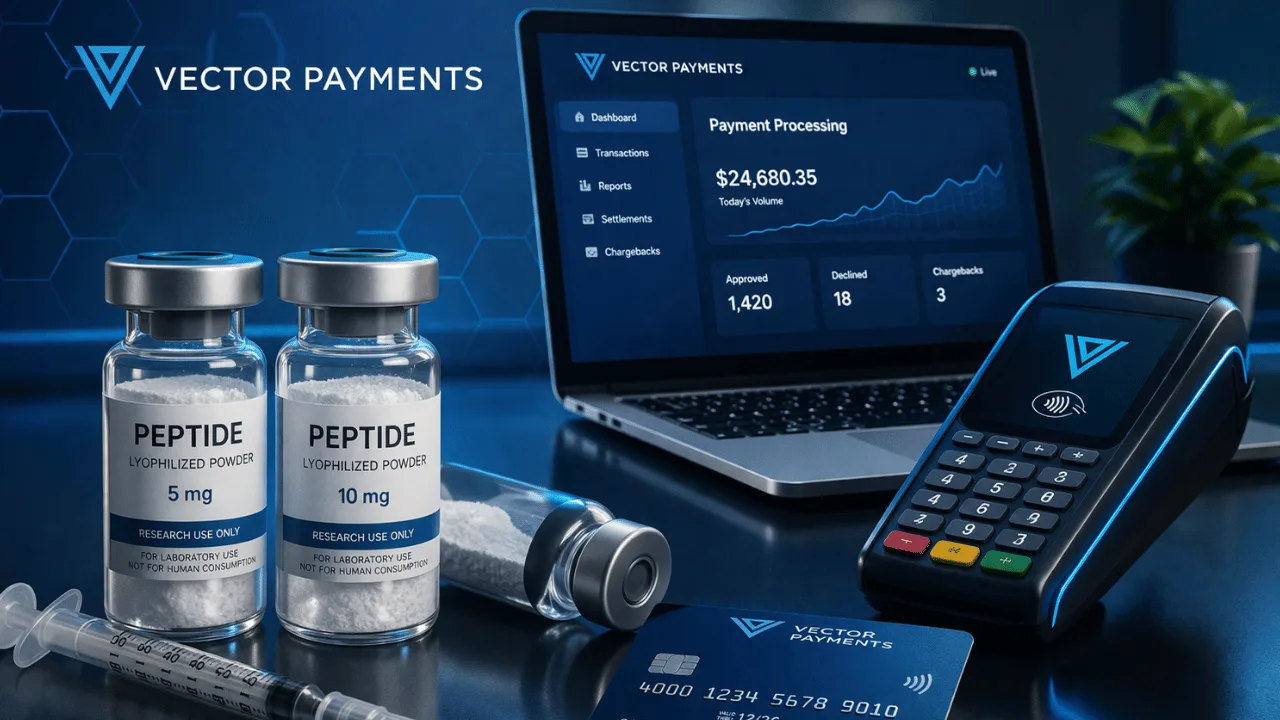
High-risk doesn’t have to mean high stress. Vector Payments keeps your peptide transactions moving.
Common Triggers for Fund Freezes
1. Sudden Increase in Sales Volume
If your business scales quickly or runs a promotion, a spike in transactions can trigger a risk review. Processors may interpret this as unusual behavior.
2. High Chargeback Activity
Chargebacks are one of the fastest ways to get flagged. Even a small increase can push your account past acceptable thresholds.
Understanding how to reduce chargebacks, especially in industries like med spas, is critical, as explained here.
3. Product Classification Issues
If your products are categorized as peptides, research chemicals, or regulated wellness items, your account may be flagged regardless of how your business operates.
4. Compliance Gaps
Missing disclaimers, unclear product descriptions, or inconsistent policies can trigger reviews and account action.
5. Processor Policy Violations
Many peptide businesses unknowingly violate acceptable use policies simply by operating in the category.
What Actually Happens When Funds Are Frozen
Once your account is flagged, the process moves quickly and without much warning.
- Your account may be restricted or fully suspended
- Incoming payments may stop processing and are placed in a reserve account
- Existing funds are placed on hold
- Access to payouts is delayed or blocked
In many cases, these actions happen automatically. As explained in this breakdown here, processors rely on automated systems that prioritize risk over business continuity.
The result is immediate pressure on your cash flow.
How Long Can Funds Be Held?
Fund holds can last anywhere from a few weeks to several months, depending on the processor and the perceived risk level.
During this time, your business is expected to continue operating without access to its revenue. For many peptide companies, this creates operational strain and limits the ability to fulfill orders, run ads, or reinvest in growth.
Why This Happens More to Peptide Businesses
Peptide businesses operate in a category that most traditional processors are not equipped to support. Even if you are compliant, your business may still be flagged because of how risk models classify your products.
This is why relying on general-purpose processors creates long-term instability.
Businesses that use peptide payment processing solutions built for high-risk industries are significantly less likely to face these disruptions.
What to Do If Your Funds Are Frozen
If your funds are currently frozen, there are a few immediate steps you should take.
- Contact your processor and request clarification
- Provide any requested documentation quickly
- Review your website for compliance gaps
- Begin preparing a transition to a high-risk processor
Many business owners assume they are stuck, but that is not the case. As explained here, you always have the option to switch to a provider that is built for your industry.
The Right Way to Prevent Fund Freezes
The only reliable way to prevent fund freezes is to work with a processor that understands your business from the start.
Proper underwriting ensures your business model, products, and risk profile are evaluated before approval, not after. If it’s too quick and easy for an approval in this type of industry, then expect risk issues down the road.
If you need guidance on setting this up correctly, review how to set up a peptide account to understand the right approach.
With High Risk Payment Processing, your business is supported by banks that are aligned with your industry.
Vector Payments is built to provide long-term stability, helping businesses avoid the disruptions caused by fund holds and account shutdowns.
Explore supported categories here: Industries
Get Approved Before It Impacts Your Business
If you are currently using a processor that is not designed for high-risk industries, your business is exposed to unnecessary risk.
The best time to secure a stable solution is before your funds are frozen.
Apply Now to move to a processor built for your business.
Or take the next step and Get Approved for a reliable merchant account.
Frequently Asked Questions
Why do payment processors freeze funds for peptide businesses?
Processors freeze funds when they detect risk related to product type, transaction behavior, or compliance concerns. Peptide businesses are more likely to trigger these reviews due to industry classification.
How long can a payment processor hold my money?
Funds can be held for several weeks or months depending on the processor’s policies and the level of risk associated with your account.
Can I get my money back after a freeze?
In most cases, funds are eventually released after a reserve period. However, the timeline is controlled by the processor and not guaranteed. Typically, they wait 6 months after your termination as that is the typical chargeback liability period for processors.
How do I prevent my funds from being frozen?
Working with a high-risk payment processor that properly underwrites your business is the most effective way to prevent fund holds.
Is switching payment processors difficult?
No. With the right provider, the transition of setting up a new peptide merchant account can be handled quickly and with minimal disruption to your business.