
Cruise Line Payment Processing: High-Risk Merchant Solutions
Operating a maritime business means navigating constant financial exposure, where a single wave of chargebacks or an unexpected merchant account freeze can instantly paralyze your operations. Cruise Line Payment Processing is one of the most operationally complex payment environments in the travel industry, spanning online bookings made months in advance, onboard point-of-sale transactions at sea, and port-side purchases across multiple currencies and jurisdictions.
Here is a quick breakdown of what cruise line payment processing actually covers:
- Online bookings and deposits: card-not-present payments collected weeks or months before sailing
- Final balance collection: scheduled payments triggered by booking deadlines
- Onboard purchases: dining, retail, spa, and entertainment charged to a guest’s cabin folio
- Excursions and port-side sales: payments processed at or near shore, sometimes with limited connectivity
- Crew payroll and remittances: cross-border payments to international crew members
What makes this particularly challenging is that cruise operators are routinely classified as high-risk merchants by acquiring banks. The reasons are straightforward: large average transaction sizes, long gaps between payment and service delivery, and elevated chargeback exposure. Cruise lines also carry MCC code 4411, which flags them for additional underwriting scrutiny before they even process their first transaction.
For any operator, from major cruise brands to river cruise and ferry operators, getting payment infrastructure right is not optional. A single account shutdown, a spike in declined transactions, or a gap in onboard POS coverage can directly impact guest experience and revenue.
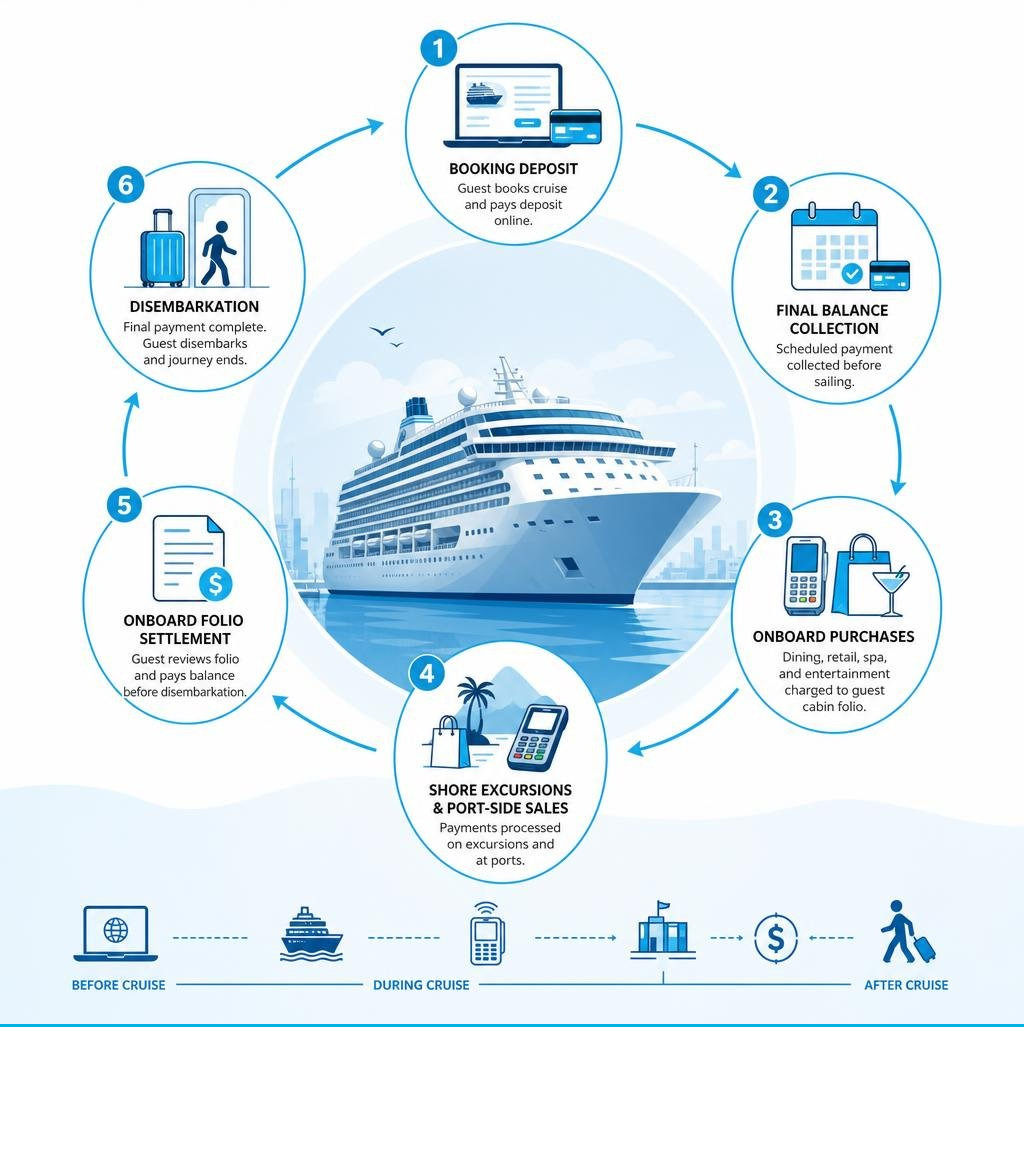
To understand how money flows in maritime commerce, we must look at the underlying architecture. Cruise line transaction processing is not a single, isolated event. It is a continuous, multi-stage lifecycle that relies on a highly specialized network of merchant accounts, payment gateways, booking engines, and onboard property management systems.
Unlike standard retail setups, cruise operators require a merchant account that can handle both high-volume card-not-present (CNP) transactions for pre-cruise bookings and card-present (CP) transactions for physical point-of-sale (POS) terminals on the ship. These systems must communicate continuously.
When a guest books a voyage, the booking engine interacts with the payment gateway to authorize the deposit. This transaction must be tokenized immediately so that the same payment credential can be passed securely to the shipboard Property Management System (SPMS). Once onboard, this token acts as the financial anchor for the guest’s cabin folio, tracking bar tabs, specialty dining, and spa treatments.
Managing this complex flow requires deep expertise in high-risk payment structures. For a comprehensive breakdown of how these pieces fit together, consult our A-Z Guide to Cruise Line Merchant Processing.
Online Booking and Reservation Payments
The online booking engine is the primary revenue engine for any cruise line. Because cruises are high-ticket luxury purchases, guests rarely pay the entire balance upfront. Instead, the payment gateway must support structured deposit collection and automated installment plans.
All of these initial transactions are classified as card-not-present, which naturally carries a higher risk of fraud. To protect your cash flow, your gateway must feature advanced fraud scrubbing, 3D Secure (3DS) authentication, and real-time card verification.
When managing installment plans, payment stability is paramount. If a scheduled installment is declined, our automated retry logic and immediate guest notification systems ensure the booking remains active without manual back-office intervention. Because we operate under strict USD transaction standards, we ensure that currency conversion and settlement clear cleanly through domestic acquiring networks, avoiding unnecessary cross-border processing fees.
To set up a secure, multi-tier reservation engine, operators should follow our Step-by-Step Guide to Cruise Line Merchant Services.
Onboard and Port-Side Transactions
Once the guest steps onto the gangway, the payment environment shifts from online e-commerce to physical, localized retail. Onboard venues, including bars, retail boutiques, casinos, and spas, function as a floating, multi-department enterprise.
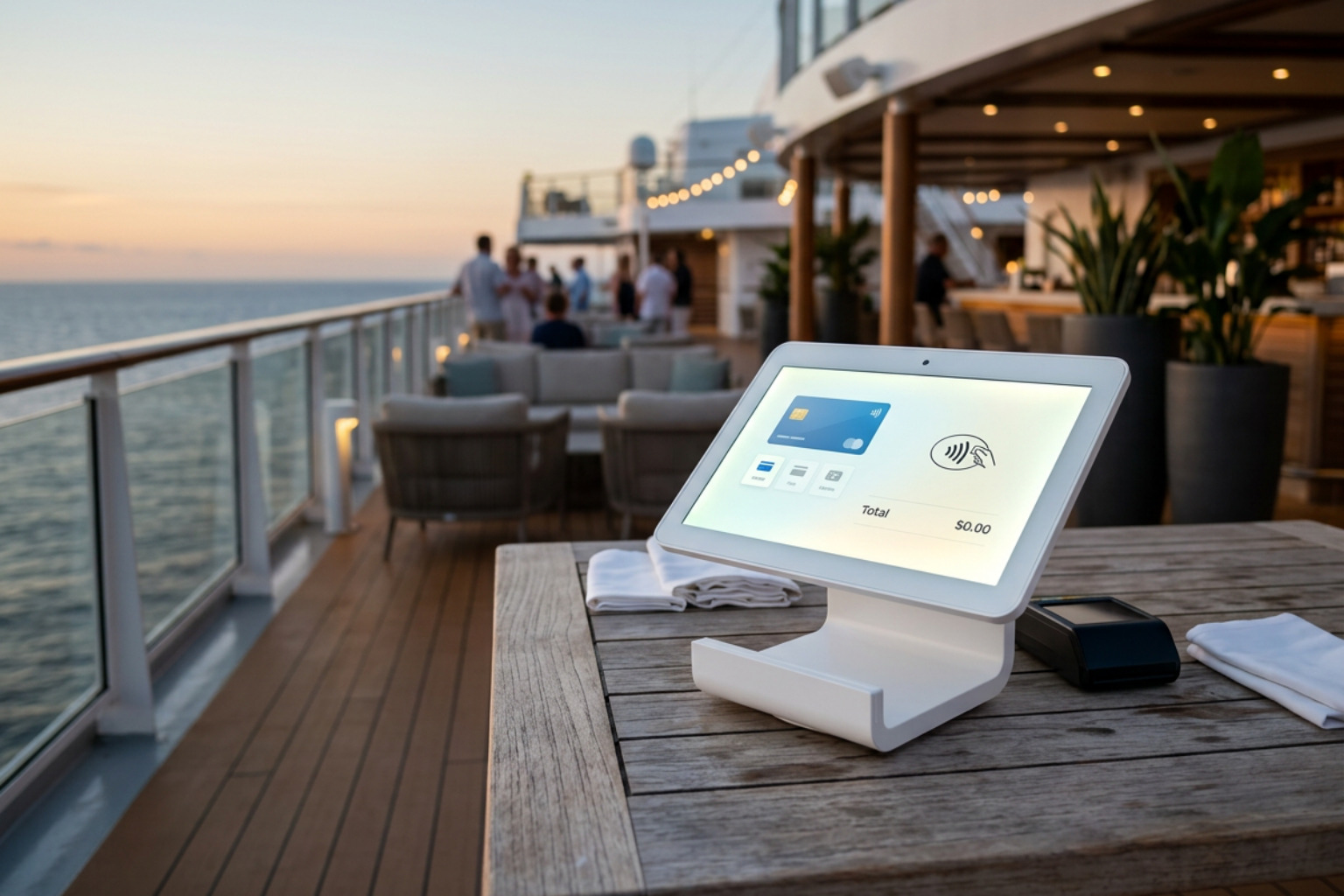
To manage this, cruise ships deploy a fleet of EMV-compliant POS terminals. These terminals must be configured to support mobile check-in and rapid, contactless card registration during embarkation. During check-in, the guest’s card is swiped or tapped once to secure a pre-authorization. This card-present transaction is tokenized and linked directly to their wearable wristband or cabin keycard.
Port-side transactions present another layer of operational friction. When a ship docks, shore excursion teams and port-side kiosks must process transactions that sync directly back to the ship’s central database. Whether processing a luxury excursion or a quick retail purchase at the pier, having robust, wireless EMV hardware ensures that transactions are captured securely, even when operating on cellular roaming or local port Wi-Fi.
Why Cruise Line Payment Processing Is Considered High-Risk
Acquiring banks do not view cruise lines the same way they view traditional brick-and-mortar retailers. In the payments industry, cruise lines are automatically designated as high-risk merchants.
The primary driver of this classification is delayed fulfillment. When a customer purchases a cruise ticket, they often do so six to twelve months before the ship actually leaves the port. During this long window, the acquiring bank holds the ultimate financial liability. If the cruise line experiences operational disruptions, bankruptcy, or mass cancellations, the bank is on the hook to refund millions of dollars in cardholder disputes.
Additionally, the high average ticket value of cruise bookings makes them a prime target for friendly fraud and criminal chargebacks. Under the standard Merchant Category Code (MCC) 4411 for steamships and cruise lines, processors enforce strict underwriting standards, higher rolling reserves, and continuous monitoring.
To navigate these strict standards and secure stable processing terms, operators must partner with specialized high-risk processors who understand the nuances of delayed fulfillment and high-ticket chargeback mitigation.
Requirements for Cruise Line Payment Processing Merchant Account Approval
Securing approval for a high-risk merchant account in the maritime sector requires meticulous preparation. Acquiring banks conduct rigorous underwriting to assess the financial stability of the operator. To obtain approval, cruise lines must typically provide:
- Comprehensive Financial Records: Multiple years of audited financial statements and corporate tax returns to prove liquidity.
- Processing History: At least three to six months of recent processing statements showing low chargeback ratios (ideally under 1%).
- Detailed Business Plan: Documentation outlining cruise itineraries, vessel ownership or charter agreements, and passenger capacity.
- Refund and Cancellation Policies: Clear, legally compliant terms of service that passengers must agree to before booking.
- Chargeback Mitigation Strategy: Proof of active fraud prevention tools, such as 3D Secure (3DS) and real-time identity verification.
Why Cruise Line Payment Processing Faces Account Shutdowns
One of the most devastating events for a cruise operator is a post-approval account shutdown. Many traditional processors will approve a high-risk merchant account initially, only to terminate the contract or freeze funds weeks later when they realize the sheer volume of high-ticket, delayed-fulfillment transactions being processed.
At Vector Payments, we focus on long-term merchant stability. We conduct thorough, upfront underwriting to ensure your account is structured correctly from day one. This proactive approach prevents sudden account freezes and sudden rolling reserve increases.
We apply the same rigorous risk-mitigation principles to other highly scrutinized, high-risk verticals, such as high-end smoke shops, vape e-commerce, and luxury med spas. Whether you are running a cruise line or managing a multi-location wellness brand, we leverage our deep relationships with acquiring banks to keep your processing active.
To learn more about how we secure high-ticket travel operations, view our dedicated guide on Travel Payment Processing.
Mitigating Chargebacks in Cruise Line Payment Processing
Chargebacks are a direct threat to merchant account stability. If your dispute ratio climbs above card brand thresholds (typically 1%), you face heavy fines, increased transaction fees, and potential termination.
To keep your dispute rates low, we recommend several practical, actionable steps:
- Clear Billing Descriptors: Ensure that your descriptor matches exactly what the customer expects to see on their bank statement (e.g.,
CRUISE-LINE-RESERVATIONS-800-XXX-XXXX). - Dispute Tracking by Reason Code: Categorize every dispute to identify if your issue stems from “service not rendered” (delayed fulfillment) or “unauthorized transaction” (fraud).
- Transparent Refund Policies: Make your cancellation and refund terms incredibly clear right next to the final payment button.
When a guest understands how to get a refund directly from you, they are far less likely to bypass your customer service team and file a chargeback with their issuing bank. To optimize your dispute mitigation strategy, read our guide on how to Make Cruise Line Payment Processing Smooth.
Common Challenges for Cruise Line Payment Processing Merchants
Operating a payment network in the middle of the ocean requires specialized maritime technology. Because satellite connectivity can be intermittent, expensive, and subject to high latency, cruise ships cannot rely on continuous, real-time cloud authorizations.
To solve this, cruise lines utilize Store and Forward (S&F) technology. When the ship is offline or satellite latency is too high, onboard POS terminals securely capture and encrypt transaction data locally. These transactions are held in an encrypted queue and then batched and synchronized to land-side servers once connectivity is restored.
To balance these two distinct environments, cruise lines manage two parallel payment pipelines:
Security Standards and Compliance at Sea
Securing cardholder data is a non-negotiable requirement, especially when transmitting data across international waters. Cruise payment systems must comply fully with the Payment Card Industry Data Security Standard (PCI DSS).
To minimize compliance scope and maximize security, modern cruise lines implement Point-to-Point Encryption (P2PE) and Tokenization. From the moment a card is swiped at the embarkation terminal or entered into an online booking form, the sensitive primary account number (PAN) is encrypted.
The ship’s internal systems never store or transmit plain-text card data. Instead, they handle secure tokens. This ensures that even if the ship’s local network is compromised, no usable credit card data can be stolen. Additionally, systems must be built to respect international privacy frameworks, such as GDPR, which govern how passenger data is handled across European and international ports.
Integrating Cruise Line Payment Processing with Property Management Systems
To achieve a seamless, cashless guest experience, your payment gateway must integrate directly with your Shipboard Property Management System (SPMS).
Through secure API integrations, every transaction made at a shipboard retail shop, bar, or restaurant is instantly posted to the guest’s cabin folio. When the cruise reaches its final night, the SPMS automatically initiates a batch settlement, charging the total folio balance to the tokenized card on file.
This native integration eliminates manual reconciliation errors, speeds up the disembarkation process, and ensures that guest billing is 100% accurate before they walk down the gangway. To discover how our customized gateways connect with maritime management systems, visit our Cruise Line Payment Processing Solutions.
Understanding Cruise Line Payment Processing Rates and Fees
Merchant processing fees for cruise lines are structured differently than standard retail accounts due to the high-risk classification. Understanding these fees is critical for managing operational margins:
- Interchange-Plus Pricing: This is the most transparent pricing model, passing the direct cost from the card brands (Visa, Mastercard, Discover, and AMEX) directly to the merchant with a pre-negotiated markup that the processing bank charges to support the account.
- Rolling Reserves: Because of delayed fulfillment, acquiring banks may require a rolling reserve (typically 5% to 10% of gross processing volume held for 90-180 days) to cover potential chargeback liabilities.
- Cross-Border and Multi-Currency Fees: Since cruise lines operate internationally, transactions processed in non-domestic currencies or cards issued by foreign banks incur additional cross-border fees, which can be optimized using local acquiring networks.
Why Vector Payments Is a Top Cruise Line Payment Processing Option
Choosing the right payment partner is critical for maintaining transaction stability, protecting cash flow, and avoiding sudden account freezes. Cruise line operators need more than a standard merchant account. They need a processor that understands high-ticket travel bookings, delayed fulfillment, onboard POS activity, and the underwriting pressure that comes with MCC 4411.
Vector Payments is a strong option for cruise lines because our team specializes in high-risk merchant processing and builds payment solutions around the realities of maritime commerce. We help cruise operators support online deposits, final balance collections, onboard purchases, port-side transactions, and secure guest folio settlement through stable, properly structured payment infrastructure.
For cruise lines, the biggest processing risk is not just getting approved. It is staying approved as volume grows, chargeback exposure changes, and sailing schedules create long gaps between payment and service delivery. Vector Payments focuses on upfront underwriting, transparent pricing, chargeback mitigation, and ongoing account support so operators can process with more confidence.
Key reasons cruise lines work with Vector Payments include:
- High-risk merchant account expertise: We understand why cruise lines receive additional scrutiny and help structure accounts to reduce the risk of freezes or sudden reserve changes.
- Support for online and onboard payments: Our solutions can support card-not-present reservations, recurring installment collections, and POS-driven onboard purchases.
- Chargeback prevention tools: We help operators reduce disputes with clearer billing descriptors, fraud screening, 3D Secure tools, and better payment documentation.
- Transparent processing guidance: Cruise operators need to understand rates, reserves, settlement timing, and approval requirements before they begin scaling payment volume.
- Dedicated support available: When payment issues affect bookings or onboard guest experience, fast support matters.

Ready to Secure Your Cruise Line Payment Processing?
At Vector Payments, we specialize in stable, high-risk merchant accounts with transparent rates and dedicated support available 7 days a week. We understand the unique operational hurdles of the travel and cruise industries, and we’re committed to protecting your business from sudden account closures and high chargeback rates.
Contact Vector Payments TodayFrequently Asked Questions about Cruise Line Payment Processing
Why are cruise lines considered high-risk by acquiring banks?
Cruise lines are classified as high-risk primarily due to delayed fulfillment, which is the long gap of several months between when a booking is paid for and when the cruise actually takes place. This extended timeline exposes banks to massive chargeback liability if the operator faces financial distress or cancellation waves. Additionally, high average ticket sizes and international transaction routing further elevate the risk profile.
How do cruise ships process payments while offline at sea?
Ships utilize Store and Forward (S&F) technology. When satellite connections are down, transactions are securely encrypted and stored locally on the ship’s onboard servers. Once the ship establishes a stable connection via satellite or port-side cellular networks, these transactions are automatically batched and sent to land-side acquiring networks for authorization and settlement.
What is the role of payment orchestration in maritime commerce?
Payment orchestration platforms allow cruise operators to route transactions dynamically through multiple regional acquiring banks. This helps optimize approval rates, minimize cross-border processing fees, and ensure redundancy. If one acquiring network experiences an outage or declines a transaction, the orchestration engine can instantly route the payment to an alternative bank to keep operations running smoothly.