
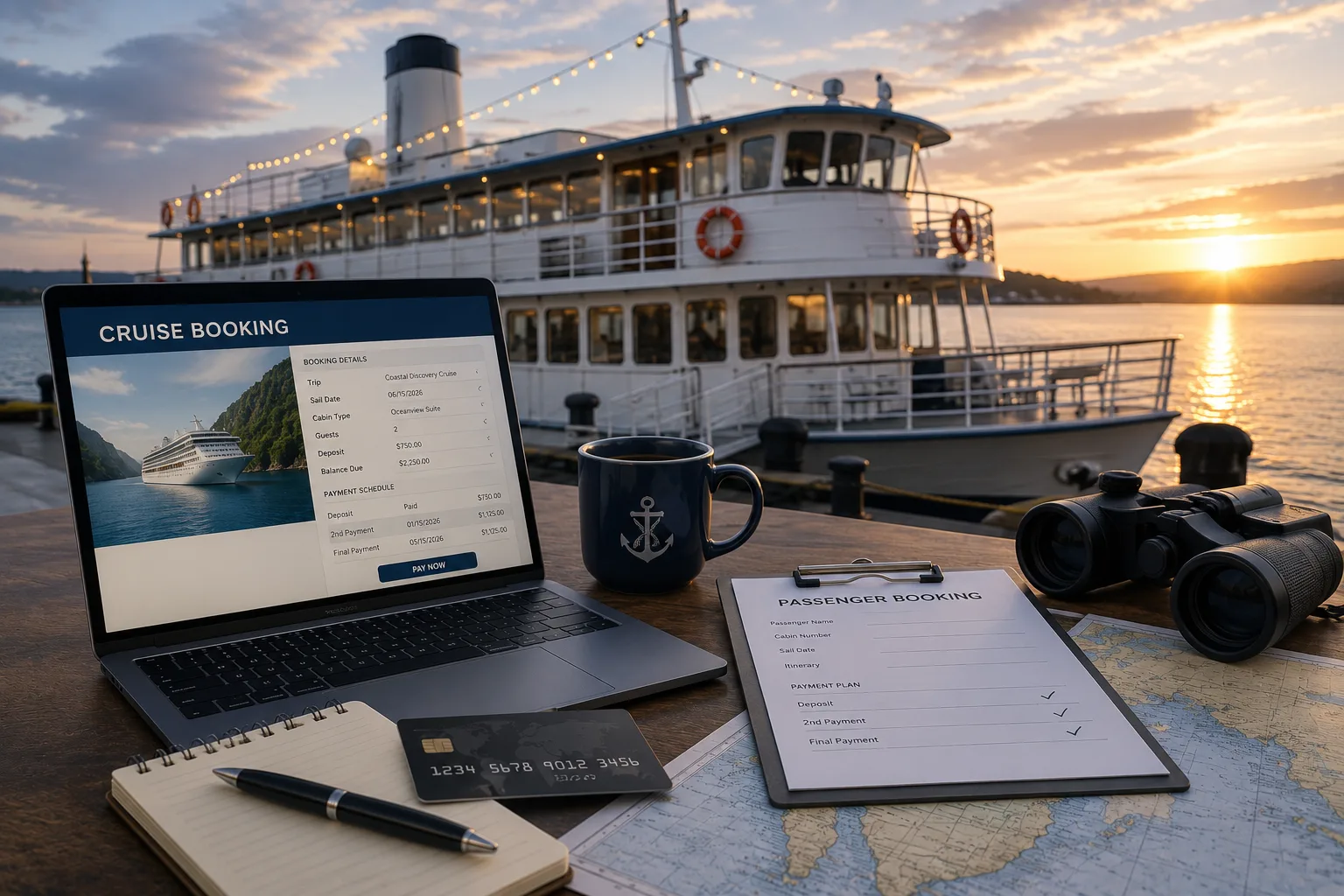
Payment processing tends to get treated as a detail you’ll figure out once the season starts. For a cruise or charter vessel operator, it’s the opposite: the processor you choose determines whether a strong first season builds momentum or gets shut down the moment volume looks unfamiliar to an automated risk system.
This guide is for cruise and charter vessel owners setting up merchant processing for the first time.
Anthony spent almost three decades running deck operations for other people’s ships before he decided it was time to run his own. His vessel is a refurbished riverboat, retrofitted for overnight and multi-day coastal cruises, carrying a few hundred passengers at a time on itineraries he designed himself: small, personal, nothing like the mega-ships he used to service. He knows knots, tides, safety drills, and crew schedules cold. What he doesn’t have is a payment processing history, because until six months ago he’d never needed a merchant account of his own.
Now he needs one badly. Guests are booking cabins six to twelve months before departure, putting down deposits and then paying the balance closer to the sailing date. Once aboard, they’ll want to pay for shore excursions, the onboard bar, a specialty dinner, and gift shop souvenirs, sometimes with a satellite connection that comes and goes as the vessel moves along the coast. Anthony has heard the horror stories: a new operator gets approved by a generic online processor, builds momentum for a season, and then gets frozen out the moment volume looks unfamiliar to an automated risk system that was never built for maritime bookings in the first place.
That fear is reasonable. It’s also avoidable. The businesses that get shut down mid-season are usually the ones that signed up with a processor that treated them like a generic e-commerce store instead of a cruise operator with a predictable, well-understood booking pattern.
Why Cruise and Charter Vessel Businesses Are Considered High-Risk
Payment processors and card networks classify cruise operators as high-risk, commonly under MCC 4411, the category for cruise lines, for reasons that have nothing to do with how well a business is run and everything to do with the shape of the transactions themselves. Three factors drive that classification.
Long booking-to-sail window. A passenger might book and pay a deposit today for a cruise that doesn’t happen for six to twelve months. That gap between money collected and service delivered is exactly the kind of exposure underwriters watch closely, because a lot can change in a year, including the passenger’s plans.
High ticket values. A multi-day cabin booking, even on a small vessel, often runs into the hundreds or thousands of dollars per passenger. Higher-value transactions mean higher-value disputes if something goes wrong.
Elevated chargeback exposure. Itinerary changes, weather cancellations, or a guest simply changing their mind can all result in a dispute rather than a refund request, and cruise bookings, more than most purchases, invite that kind of after-the-fact reconsideration.
None of this means a new operator is a bad business. It means the risk profile is well-known, and the right processor already knows how to underwrite and support it.
How to Choose a Payment Processor When You’re Starting a Cruise or Charter Business
Confirm They Understand Deposit-Based, Long-Lead-Time Bookings
Ask directly how the processor handles a deposit collected today against a sail date months away, followed by one or more balance payments before departure. A processor unfamiliar with maritime or travel bookings may flag this pattern as suspicious rather than routine. You want staged and installment billing tools designed for exactly this cadence, deposit now, balance due closer to sailing, not a workaround you have to build yourself.
Ask About Onboard POS and Offline Connectivity
Once passengers are aboard, they’ll want to pay for excursions, dining, and retail, often while your vessel has limited or intermittent satellite connectivity. A modern POS system built for this environment should be able to capture a transaction offline and sync it automatically once a signal returns, so a spotty connection at sea never means a lost sale or an awkward “cash only” moment at the bar.
Understand Chargeback Ratio Thresholds and Monitoring
Ask what chargeback ratio triggers extra scrutiny. Card network monitoring programs commonly activate around the 1% mark, and once an account is flagged, terms can tighten quickly or the account can be terminated. A processor experienced with cruise and charter businesses should offer chargeback monitoring support and practical guidance for keeping your ratio well under that threshold, not just a warning letter after the fact.
Check Multi-Currency and International Support
If you expect passengers booking from outside the U.S., or you operate itineraries that touch international ports, confirm the processor can settle in multiple currencies without forcing awkward conversions or surprise fees on your guests. This matters more than owners of a single-market business often expect.
Compare Pricing Transparency
On a small-vessel operation, margins are tight and every processing fee matters. Look for transparent, predictable pricing rather than bundled rates that hide markups. Ask specifically about dual pricing and surcharging options, and whether 0% processing programs are available: these can meaningfully offset the cost of accepting cards without raising your list prices.
Generic Processor vs. Vector Payments for Cruise and Charter
| Consideration | Generic / Mainstream Processor | Vector Payments Cruise & Charter Merchant Account |
|---|---|---|
| Approval likelihood for new/small operators | Often declined or approved with heavy restrictions due to no processing history | Evaluated on the merits of the business model, with high-risk underwriting expertise |
| Handling of deposit/staged payments | May flag deposit-then-balance patterns as irregular | Built-in staged and recurring billing tools for deposit-now, balance-later bookings |
| Onboard/offline POS support | Typically requires constant connectivity | Modern POS captures transactions offline and syncs once connectivity returns |
| Chargeback monitoring support | Limited guidance; account often terminated once thresholds are hit | Proactive monitoring and support to help stay under threshold ratios |
| Pricing transparency | Bundled rates that can obscure true cost | Transparent pricing, with dual pricing and surcharging options available |
| Support when issues arise | Automated, generic support queues | Real customer support familiar with maritime and travel bookings |
Why Cruise and Charter Operators Choose Vector Payments
Vector Payments works with cruise and charter vessel operators as a matter of specialty, not as an exception to a generic underwriting model.
Fast approvals. Grounded in an understanding of how maritime bookings actually work, with stable merchant accounts that aren’t pulled the moment volume grows.
Omnichannel support. One system covering the booking website, the dockside box office, and the onboard POS, along with recurring and staged billing built for deposit-based sales.
Margin protection. Dual pricing and surcharging options, along with 0% processing where it fits, help protect margins on a smaller vessel.
Real support when it matters most. When a chargeback spike or a connectivity outage happens mid-season, there’s a real support team on the other end of the phone, not a bot.
Vector’s broader experience across high-risk payment processing means the underwriting team has seen this pattern before and knows how to set an account up for the long term, not just the first sailing season.
Frequently Asked Questions
Why is my new cruise or charter business considered high-risk if I haven’t had a single chargeback yet?
The classification is based on the industry and transaction pattern (long booking windows, high ticket values, and cancellation exposure), not on your personal track record. It applies from day one regardless of how well you run your operation.
Can I still get approved with no processing history at all?
Yes, but it depends on the processor. A generic online processor evaluated purely by algorithm may decline a business with no history. A processor with high-risk and maritime expertise can underwrite based on your business model, itinerary, and operating plan instead of past volume alone.
What happens if my onboard POS loses satellite connection mid-transaction?
With a POS system built for offline capture, the transaction is stored locally and processed automatically once connectivity returns, so you don’t lose the sale or have to fall back to cash.
How do I keep my chargeback ratio under the threshold that triggers monitoring?
Clear cancellation and itinerary-change policies communicated at booking, prompt refunds when appropriate, and working with a processor that actively monitors your ratio and flags issues early all help keep you under the roughly 1% threshold that typically triggers card network scrutiny.
Do I need different tools for deposits versus onboard purchases?
Not necessarily. The right setup uses one merchant account that supports staged/recurring billing for deposits and balances alongside a modern POS for onboard dining, excursions, and retail, so booking payments and onboard payments reconcile together instead of living in separate systems.
Ready to Set Sail With a Payment Partner That Understands Your Business?
Vector Payments builds merchant accounts for cruise and charter vessel operators of every size, from single-vessel startups to growing fleets. Talk to a specialist about deposit-based billing, onboard POS, and long-term account stability. Call 888-237-1754 to speak with a Vector Payments specialist today.