
CBD Payment Gateway 101
Securing a Stable CBD E-Commerce Payment Gateway for Your Online Hemp Business
Operating an online hemp business means constantly walking a tightrope where a single compliance flag can instantly freeze your funds and shut down your checkout overnight. To survive this volatile landscape, securing a dedicated CBD e-commerce payment gateway is not just an option, it is the single most critical shield protecting your business from sudden financial collapse.
Quick answer for CBD merchants:
You built a legitimate, compliant CBD brand. Your products are lab-tested, your labels are clean, your COAs are current. Then one morning you log in and your payment account is frozen – no warning, no explanation beyond a vague terms-of-service notice.
This is not an edge case. It is the norm for CBD merchants using the wrong processor.
The global CBD market is on track to reach $47.22 billion by 2028, up from $4.9 billion in 2021. The opportunity is real and growing fast. But the payment infrastructure most merchants start with – general-purpose aggregators and default checkout tools – was never built to support this industry long-term.
The problem is not your business. It is the mismatch between aggregator-style processors and the compliance requirements that come with selling hemp-derived products.
This guide breaks down exactly how CBD payment processing works, what to look for in a gateway, and how to build payment infrastructure that will not collapse the moment your volume starts to scale.
Why CBD E-commerce Payment Gateway Payment Processing Is Considered High-Risk
To understand why a specialized CBD e-commerce payment gateway is necessary, we must first address why financial institutions place hemp and CBD products into the high-risk category. In the payments industry, high-risk is not a reflection of your business ethics or your personal credit score; it is a calculation of regulatory complexity, transaction environments, and financial liability.
First, online CBD sales are categorized as card-not-present (CNP) transactions. Because the card is not physically swiped or dipped at a terminal, CNP transactions carry an inherently higher risk of fraud and chargebacks. For banks, this risk is amplified when paired with alternative medicine products.
Second, the regulatory landscape surrounding hemp-derived cannabinoids is highly fragmented. While the federal framework provides baseline rules, individual states and local jurisdictions maintain their own restrictions on ingestibles, topicals, and smokable hemp flower. This regulatory patchwork makes traditional banks incredibly nervous.
Additionally, many high-risk businesses including smoke shops, vape stores, and high-end med spas, regularly introduce CBD products into their inventory to meet consumer demand. Because these physical and digital storefronts operate in highly regulated spaces, acquiring banks must perform rigorous compliance checks to ensure every product sold meets legal standards. We specialize in helping these businesses navigate the complex apply for CBD and hemp payment processing to secure stable, long-term processing.
Why Mainstream Processors Reject Your CBD E-commerce Payment Gateway
The most common mistake new CBD merchants make is signing up with a mainstream payment aggregator. Aggregators pool thousands of different merchants under a single, shared merchant ID (MID). This allows them to offer instant, frictionless onboarding. However, this convenience comes with a massive catch.
Mainstream aggregators rely on automated underwriting systems. Their acceptable use policies strictly prohibit high-risk products, including hemp-derived CBD. When you sign up, their automated system might approve your account immediately because no human has actually reviewed your business model.
But the moment your store starts processing transactions, their risk algorithms will flag keywords like CBD, hemp, gummies, or tincture. This triggers a manual compliance review, resulting in:
- Immediate Account Freezes: Your ability to accept payments is cut off instantly.
- Fund Holds: Your processed revenue is locked in a rolling reserve or held entirely for 90 to 180 days to cover potential chargebacks.
- Massive Transaction Declines: Customer attempts to purchase your products are declined, damaging customer trust and revenue continuity.
To build a sustainable business, you must bypass these aggregators and work with a partner that understands the unique needs of high-risk merchants. For a deeper look at why specialized solutions are required for long-term survival, read our guide on how to secure the best payment processing for small business owners.
The Legal Landscape: Farm Bill Compliance and THC Limits
The foundational law governing the modern CBD industry is the 2018 Farm Bill, which federally legalized hemp-derived products containing a Delta-9 THC concentration of no more than 0.3% on a dry weight basis.
However, legalizing the plant did not automatically make payment processing simple. In 2026, compliance standards are tighter than ever. The FDA continues to monitor the market closely, strictly prohibiting CBD brands from making unapproved medical or therapeutic claims. If your website claims that your CBD oil can cure anxiety, treat depression, or relieve chronic pain, underwriters will immediately reject your application.
To secure a compliant integrate reliable CBD hemp payment processing account, your business must prove that it operates entirely within these legal boundaries. Underwriters will meticulously review your product labels, marketing copy, and third-party laboratory reports to verify that your inventory remains compliant with federal and state guidelines.
Requirements for CBD E-commerce Payment Gateway Merchant Account Approval
Selecting the right payment infrastructure is one of the most critical decisions you will make for your online store. You cannot simply plug in any standard gateway and hope for the best; you need a robust gateway backed by a dedicated merchant account setup that has cleared high-risk underwriting.
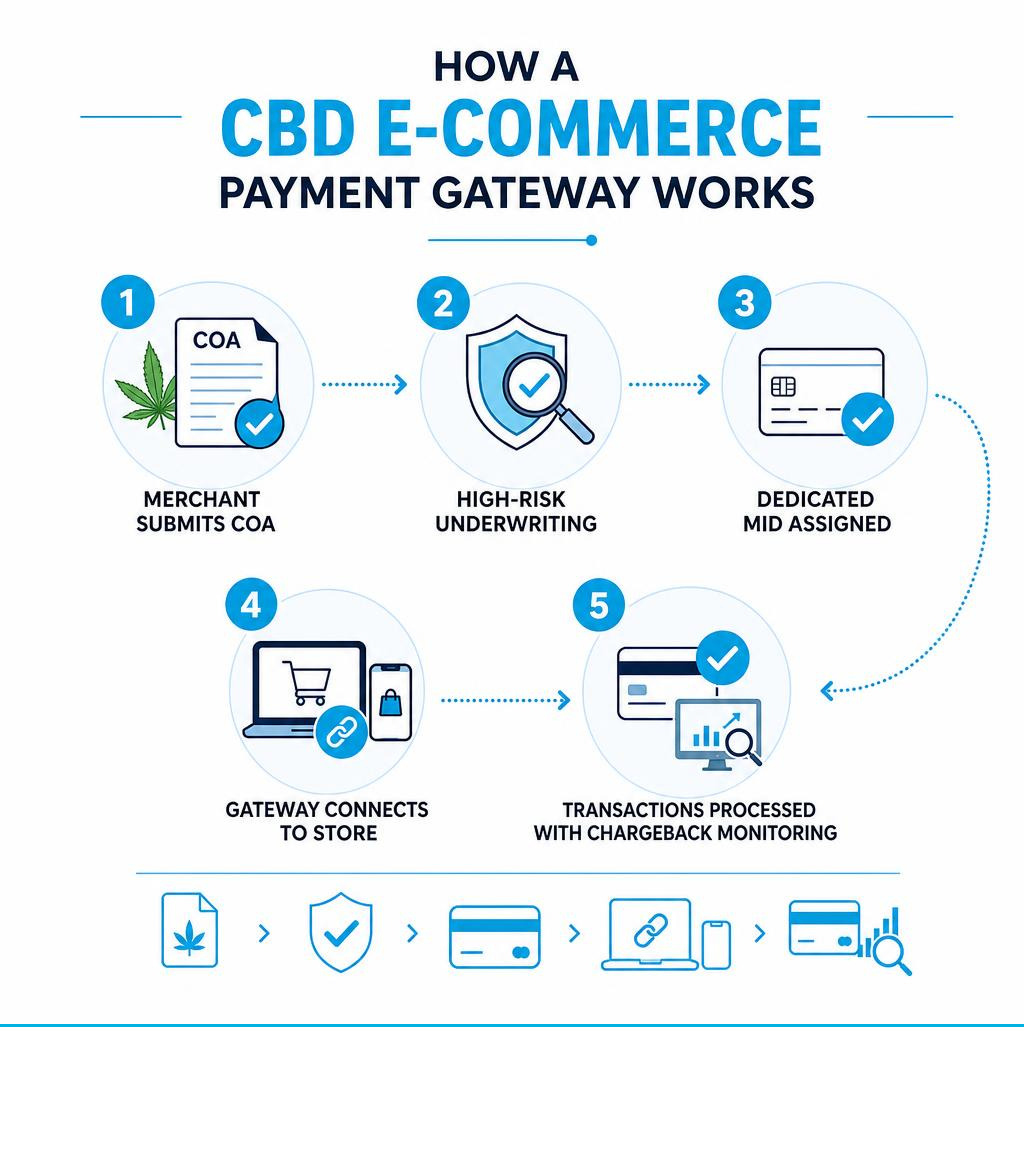
When evaluating your options, you should look for providers with a deep, established network of CBD-friendly sponsor banks. Because state laws and card brand guidelines can shift, having a processor with bank redundancy is vital. If one acquiring bank decides to tighten its policy on certain hemp products, a reliable processor can seamlessly transition your transactions to another banking partner without causing downtime.
For a comprehensive overview of how to select the right gateway for your business, explore popular payment gateways for easy and secure transactions.
Essential Features: Chargeback Mitigation and Multi-Currency Support
A high-quality CBD e-commerce payment gateway must offer more than just a checkout form. It needs enterprise-grade features designed to protect your revenue and help your business scale globally.
- Proactive Chargeback Protection: High-risk merchants are highly susceptible to friendly fraud and chargebacks. Your gateway should feature built-in chargeback mitigation tools, such as real-time alerts and automatic dispute resolution, to keep your chargeback ratio safely below the industry-standard 1% threshold.
- Multi-Currency and Global Reach: If you plan to expand internationally, your gateway should support multiple presentment currencies. Some advanced high-risk gateways offer up to 180 presentment currencies, allowing customers worldwide to pay in their local currency while you settle in USD.
- Compliant Recurring Billing: CBD is highly suited for subscription models, such as monthly wellness boxes or auto-ship tinctures. Your gateway must support secure, compliant recurring billing that securely stores customer data in a PCI-compliant vault.
Implementing these features is essential for optimizing your online storefront. Learn more about maximizing your digital sales and how to optimize your ecommerce merchant services.
Technical Integration of a CBD E-commerce Payment Gateway
Integrating a high-risk gateway into your online store does not require you to rebuild your website from scratch. Modern CBD gateways utilize flexible API integrations and pre-built plugins that connect directly to your existing shopping cart.
Whether you are running a custom-built website or utilizing a popular e-commerce platform, the integration process should be seamless, secure, and fully PCI-compliant. The gateway should handle the sensitive card data entirely on its secure servers, minimizing your business’s PCI compliance burden.
To ensure your integration is executed correctly without disrupting your customer experience, review our step-by-step guide to master integrating payment gateway solutions.
Understanding CBD E-commerce Payment Gateway Payment Processing Rates and Fees
High-risk merchant accounts operate on different pricing structures than standard low-risk accounts. Because of the regulatory complexities and chargeback risks associated with hemp-derived products, processors charge higher rates to offset their financial exposure.
Instead of flat-rate pricing models that often hide penalties, reputable high-risk processors utilize interchange-plus pricing. This transparent model breaks down the exact cost of the card brand interchange fee alongside the processor’s markup. When setting up your CBD e-commerce payment gateway, expect to see slightly higher transaction fees, monthly gateway maintenance fees, and potentially a rolling reserve if you’re a new business with no processing.
Top CBD E-commerce Payment Gateway Payment Processing Providers
Finding a reliable provider requires looking beyond standard aggregators. The top high-risk payment processing providers are those that offer dedicated merchant accounts, direct relationships with multiple sponsor banks, and robust fraud prevention tools built directly into the gateway.
Vector Payments stands out as a premier provider in this space. By bypassing unstable shared-pool models, Vector Payments pairs your business with a dedicated Merchant ID (MID) underwritten by CBD-friendly banks. This ensures long-term stability, transparent pricing, and the flexibility to scale your online store without fear of sudden account termination.
Why CBD E-commerce Payment Gateway Face Account Shutdowns
Getting approved for a CBD merchant account is only half the battle. The real challenge is maintaining that account long-term and preventing post-approval shutdowns. Many merchants celebrate their initial approval, only to face account termination a few months later due to preventable compliance mistakes or sudden spikes in transaction declines.
To protect your business from sudden payment disruptions, you must understand the key differences between a dedicated merchant account and a shared aggregator account:
Managing Chargeback Ratios and Fraud Prevention
The single most common reason a dedicated CBD merchant account gets shut down is an unmanaged chargeback ratio. Visa and Mastercard monitor high-risk merchants closely. If your chargeback ratio climbs above 1% of your total monthly transaction volume, your merchant account may be flagged for mandatory review.
To prevent this, you must implement a multi-layered fraud prevention strategy:
- Utilize 3D Secure 2 (3DS2): This protocol adds an extra layer of authentication for online card transactions, shifting the liability of fraudulent chargebacks from your business to the card issuer.
- Set Up Clear Billing Descriptors: Ensure the name that appears on your customer’s bank statement matches the name of your website. If a customer buys CBD oil from HempWellness.com but the bank statement reads HW Holdings LLC, they may not recognize the charge and file a dispute.
- Deploy Advanced Fraud Filters: Use velocity checks, IP address verification, and card verification value (CVV) matches to block suspicious transactions before they are processed.
For a deeper dive into protecting your business from financial disputes, check out our guide to secure the best payment processing for small business owners.
The Danger of Aggregators and the Need for Dedicated MIDs
When you use a payment aggregator, you are sharing a risk pool with thousands of other businesses. If several other merchants in that pool experience a sudden spike in fraud or chargebacks, the aggregator may decide to mitigate its risk by mass-terminating accounts in high-risk categories like CBD.
With a dedicated Merchant ID (MID) underwritten specifically for your business, your account stability is completely independent of other merchants. The sponsor bank has reviewed your business model, checked your COAs, and approved your specific product catalog. This upfront underwriting process ensures that as long as you operate within your approved guidelines and keep your chargeback ratio low, your account is secure.
Furthermore, we design our payment infrastructure with bank redundancy. If one of our acquiring bank partners updates its internal policies regarding specific cannabinoids, we can quickly transition your dedicated MID to another partner in our network, ensuring zero operational downtime. To learn more about securing a dedicated MID for your digital storefront, optimize your ecommerce merchant services.
Common Challenges for CBD E-commerce Payment Gateway Merchants
Beyond account shutdowns, merchants face several ongoing operational hurdles. These include navigating shifting state-by-state regulations, managing high customer acquisition costs, and dealing with higher-than-average transaction decline rates. Because many traditional banks block transactions associated with hemp keywords, having a specialized CBD e-commerce payment gateway that utilizes advanced routing and pre-underwritten merchant accounts is essential to maintaining high authorization rates and keeping your checkout process seamless.
Partner with Vector Payments for Stable CBD Processing
At Vector Payments, we specialize in stable, secure, and transparent payment processing for high-risk merchants, including CBD brands, smoke shops, vape stores, and med spas. We bypass unstable aggregator models to pair your business with a dedicated merchant account underwritten by CBD-friendly sponsor banks, backed by low-risk pricing, transparent rates, and dedicated 7-day support.
Explore CBD Hemp Payment ProcessingFrequently Asked Questions About CBD Merchant Accounts
Navigating high-risk merchant services can be confusing. To help you make the most informed decisions for your online store, we have compiled answers to some of the most frequently asked questions.
Can I use hosted or open-source e-commerce platforms for CBD sales?
Yes, you can use hosted storefronts or open-source commerce systems to sell CBD products, but you cannot rely on every native, out-of-the-box payment option that comes with those platforms.
Many e-commerce platforms allow CBD merchants to build storefronts, manage inventory, and support product pages. The payment layer is where the risk changes. To sell CBD online without inviting post-approval shutdowns, you must integrate a compliant, third-party high-risk payment gateway connected to a dedicated merchant account.
Open-source commerce setups are also popular for CBD sales because they are flexible and customizable. By pairing your store with a specialized gateway through an approved integration, you can accept credit cards, manage subscriptions, and process transactions securely. If you are also utilizing alternative business models, you may find our guide on low-risk dropshipping payment processing helpful for structuring your setup.
What is a Certificate of Analysis (COA) and why is it required?
A Certificate of Analysis (COA) is a verified document from an independent, third-party laboratory that details the exact cannabinoid profile of your products. It acts as proof that your products comply with the 2018 Farm Bill by showing that the Delta-9 THC content is at or below the legal 0.3% limit.
Acquiring banks and high-risk underwriters require up-to-date COAs (usually issued within the last 18-24 months) for every single CBD product listed on your website. They use these reports to verify that you are not selling federally prohibited substances. Failing to provide clear, matching COAs for your entire inventory will result in an immediate rejection of your merchant account application.
How does subscription billing work for CBD products?
Subscription billing is an excellent way to build customer loyalty and secure predictable, recurring revenue for your CBD brand. However, because subscription models naturally carry a higher risk of chargebacks (often due to customers forgetting about recurring shipments), your payment gateway must be specifically configured to handle this risk.
A compliant CBD subscription setup requires a gateway that securely vaults customer credit card details using tokenization. It should also feature automated dunning management, which automatically retries declined cards and sends friendly notifications to customers before their card is charged, to minimize involuntary churn and prevent disputes.