

Operating a hemp business without an approved CBD payment processor is a fast track to frozen funds, sudden account terminations, and lost revenue. Finding a reliable, approved CBD payment processor is one of the most common and most frustrating challenges facing hemp and CBD business owners in 2026.
Quick answer: What is an approved CBD payment processor?
The global CBD market is on track to reach $47 billion by 2028, up from just $4.9 billion in 2021 and the CBD therapeutics segment alone is projected to hit $9.30 billion in 2026. That’s a serious business opportunity.
But here’s the problem: most mainstream payment processors treat legitimate, compliant CBD businesses the same way they treat bad actors. Automated systems flag your account. Funds get held. Sometimes for months with no explanation beyond a vague terms-of-service violation.
This isn’t a compliance failure on your part. It’s a structural mismatch between how mainstream payment aggregators operate and what CBD merchants actually need: a properly underwritten merchant account from an acquiring bank that has explicitly approved hemp-related commerce.
The good news? The right processor exists and getting approved is absolutely achievable with the right documentation and setup.
Why Approved CBD Payment Processor Payment Processing Is Considered High-Risk
The hemp and CBD industry operates in a unique legal gray area that terrifies traditional financial institutions. Even though hemp-derived CBD is federally legal under the 2018 Farm Bill, the financial ecosystem has been incredibly slow to adapt. This mismatch is why your business cannot rely on standard, low-risk credit card processing.
When you process a transaction, multiple entities are involved: your business, the payment gateway, the acquiring bank (the bank that processes the credit card payments on your behalf), and the issuing bank (the customer’s bank). Because CBD products are derived from the cannabis plant, many conservative acquiring banks refuse to touch these transactions. They fear potential regulatory shifts, class-action lawsuits, and the administrative burden of monitoring compliance.
Furthermore, a significant portion of CBD sales occurs online. Card-not-present (CNP) transactions carry inherently higher fraud risks than in-person retail swipes. When you combine the regulatory uncertainties of hemp with the typical risks of e-commerce, traditional banks quickly classify the entire industry as “high-risk.”
Without an underwritten high-risk merchant account, your business is constantly exposed to transaction instability. A specialized, approved CBD payment processor is the only way to secure a dedicated Merchant Identification Number (MID) that is explicitly underwritten for hemp sales. This ensures your transactions are processed legally, stably, and without the constant threat of sudden disruption.
Why Mainstream Aggregators Fail as an Approved CBD Payment Processor
Mainstream payment aggregators are built for low-risk, highly predictable businesses. They use a “shared merchant account” model, where thousands of different businesses process payments under a single master merchant account. To keep onboarding fast, they approve accounts almost instantly with little to no upfront underwriting.
This works perfectly for a standard coffee shop or a clothing boutique. But for a high-risk CBD business, it is a termination waiting to happen.
Because aggregators do not perform underwriting during onboarding, their automated risk-management algorithms run constantly in the background. The moment their systems detect keywords like “CBD,” “hemp,” “gummy,” or “tincture” on your website, or notice a minor spike in transaction volume, your account is flagged.
The consequences are severe:
- Immediate Account Freezes: Your ability to accept credit cards is turned off instantly, often right before major sales events or holidays.
- Extended Fund Holds: Aggregators can legally hold your processing revenue for 90 to 180 days to cover potential chargebacks, starving your business of necessary cash flow.
- Sudden Terminations: Your account is permanently closed with no path for appeal, forcing you to scramble for a replacement while losing thousands of dollars in daily sales.
To understand why these low-risk models are entirely unsuited for your business, apply for a high-risk merchant account to secure your processing infrastructure. Relying on an aggregator is not a long-term strategy; it is a gamble that puts your entire business infrastructure at risk.
Shifting Regulations and State-Level Compliance
Navigating CBD compliance requires a deep understanding of both federal mandates and local laws. Federally, the 2018 Farm Bill established that hemp-derived products must contain 0.3% Delta-9 THC or less on a dry-weight basis. Any product exceeding this threshold is legally classified as marijuana, which remains a controlled substance under federal law.
However, state-level regulations create a complex patchwork of rules that approved processors must strictly enforce. For example, in Massachusetts and specifically within our local market of Boston, merchants operating physical smoke shops, vape stores, or high-end med spas must comply with strict local licensing, age-verification requirements, and product-labeling standards.
Additionally, the Food and Drug Administration (FDA) strictly prohibits CBD brands from making unapproved medical or health claims. You cannot advertise that your CBD products “cure anxiety,” “treat chronic pain,” “heal inflammation,” or “mitigate PTSD.”
Approved CBD payment processors employ specialized underwriting teams that review your online store and product labels to ensure compliance with these rules. If your website contains prohibited health claims, your application will be declined. Working with a processor that understands these nuances protects your business from regulatory fines and keeps your merchant account in good standing.
Understanding Approved CBD Payment Processor Payment Processing Rates and Fees
Selecting the right partner to handle your credit card transactions is one of the most critical decisions you will make. You should not simply look for the lowest headline rate; instead, evaluate the processor’s underlying infrastructure, bank relationships, and risk-management capabilities.

A reliable processor must offer a robust, high-risk payment gateway that integrates seamlessly with your point-of-sale (POS) hardware and online shopping cart. It should also have established relationships with multiple domestic acquiring banks. This multi-bank redundancy ensures that if one bank alters its underwriting guidelines for hemp, your transactions can be seamlessly routed to another partner without disrupting your operations.
To learn more about how we structure stable, long-term processing solutions for hemp retailers, secure a CBD hemp payment processing solution that protects your revenue.
Essential Security and Gateway Integrations
Your payment gateway is the bridge between your customer’s credit card and your bank account. For high-risk industries, the gateway must be highly secure and compliant with the latest Payment Card Industry Data Security Standards (PCI-DSS Level 1).
Key features to look for in a CBD-compliant payment gateway include:
- Point-to-Point Encryption (P2PE): Ensures sensitive cardholder data is encrypted from the moment it is entered, protecting your business from data breaches.
- Advanced Tokenization: Replaces credit card details with secure tokens, allowing you to safely process recurring subscription billing and auto-ship orders.
- Seamless API Integrations: The gateway must connect easily with major e-commerce platforms like WooCommerce, BigCommerce, and custom cart systems without requiring complex coding.
- 3D Secure (3DS): Adds an extra layer of identity verification for online shoppers, significantly reducing fraudulent transactions and chargebacks.
If you are running a regulated business, check out our insights on high-risk regulated merchant services to ensure your online checkout is fully optimized and secure.
Fee Structures and Pricing Models
Because CBD is classified as a high-risk industry, processing fees are higher than standard low-risk rates. While a traditional business might pay 2% to 3% per transaction, approved CBD payment processing fees typically run 3.5% to 4.5%.
Avoid processors that offer flat-rate blended pricing, as these models often hide junk fees and inflated markups. Instead, insist on Interchange-Plus pricing. This transparent model breaks down the exact cost charged by the card brands (Visa, Mastercard, Discover, and AMEX) and shows you the precise markup charged by your processor.
Here is a direct comparison of typical fee structures:
While high-risk fees are higher, working with an approved processor can lead to a 30% to 40% increase in overall revenue simply by eliminating declined transactions and keeping your checkout online consistently.
Requirements for Approved CBD Payment Processor Merchant Account Approval
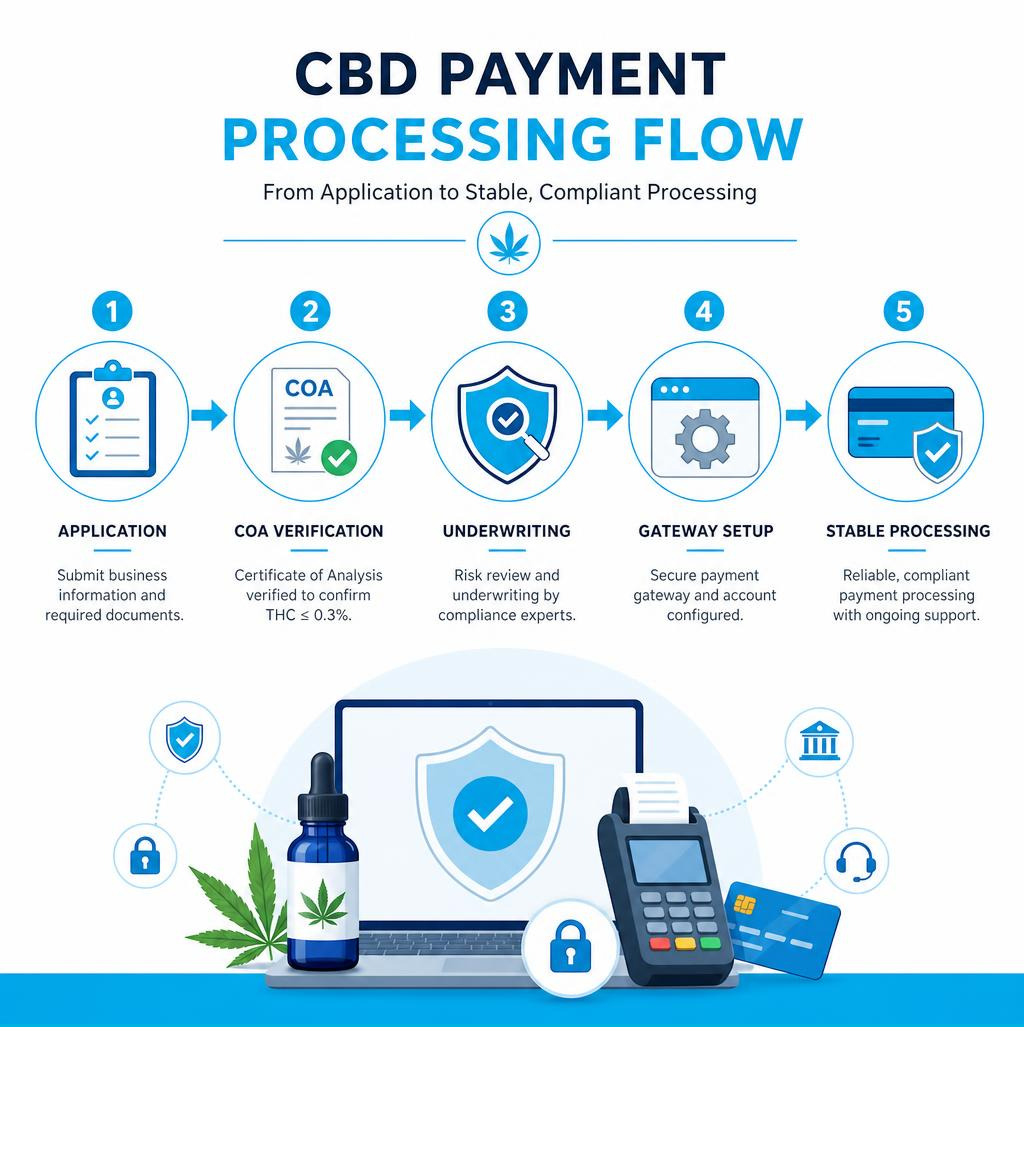
Unlike standard processors that approve accounts instantly and ask questions later, approved high-risk processors perform upfront underwriting. This means our compliance and risk teams verify your business’s legitimacy and financial stability before you process your first transaction. While this requires more effort initially, it guarantees long-term account stability.
To understand the complete step-by-step onboarding journey, review our breakdown of the approved CBD and hemp payment process setup.
How to Apply and Get Onboarded with an Approved CBD Payment Processor
To ensure a smooth and rapid approval process (typically within 48 to 72 hours for pre-approval), you must have your corporate documentation organized and ready for submission.
Onboarding Checklist for CBD Merchants:
- Government-Issued Photo ID: For all business owners with 25% or more equity.
- Business Registration & EIN: Articles of Organization/Incorporation and federal tax ID documents.
- Recent Bank Statements: 3 months of corporate bank statements showing healthy operating capital.
- Processing History (If Applicable): 3 months of recent processing statements showing low chargeback ratios.
- Live, Compliant Website: A fully functional website with secure SSL checkout, clear product descriptions, prominent refund and shipping policies, and age-verification prompts.
- Certificates of Analysis (COAs): Third-party lab reports for every single CBD product offered on your storefront.
Having these documents ready prevents processing delays and demonstrates to underwriting sponsors that your business is a stable, well-managed operation.
The Critical Role of Certificates of Analysis (COAs)
A Certificate of Analysis (COA) is a mandatory document issued by an independent, accredited third-party laboratory. It details the exact chemical makeup of your product, including the concentration of various cannabinoids (CBD, CBG, CBN) and, most importantly, the percentage of Delta-9 THC.
Underwriters require current COAs (typically dated within the last 12 months) for several critical reasons:
- Legal Verification: They prove that your products contain 0.3% THC or less, verifying compliance with the 2018 Farm Bill.
- Safety & Purity: They confirm the products are free from harmful contaminants like heavy metals, pesticides, and residual solvents.
- Brand Legitimacy: They show that your business is committed to transparency, accurate labeling, and consumer safety.
Additionally, our underwriting team will audit your website to ensure you do not make any medical or health-related claims. If your product descriptions or blog posts suggest that your CBD oils can treat illnesses, you will be required to remove those claims before your merchant account is approved.
Why Approved CBD Payment Processor Face Account Shutdowns
Getting your merchant account approved is only the first step. To ensure your payment processing remains stable and active, you must actively manage risk and implement fraud-prevention protocols.
Visa and Mastercard monitor merchant accounts closely. If your chargeback ratio exceeds 1% of your total monthly transaction volume, your account will be flagged, and you risk being placed on the MATCH (Member Alert to Merchants Effectively Terminated) list. Being placed on the MATCH list makes it incredibly difficult to secure payment processing with any financial institution for up to five years.
To keep your business protected and running smoothly, implement the security practices outlined in our comprehensive guide to stable CBD hemp payment processing.
Mitigating Chargebacks and Fraud
The most common cause of high-risk merchant account closures is chargebacks. In the CBD space, chargebacks often stem from customer confusion, shipping delays, or “friendly fraud” (customers claiming they didn’t authorize a purchase to get a refund).
To protect your business, implement these proven mitigation strategies:
- Clear Billing Descriptors: Ensure the name that appears on your customer’s credit card statement matches your website’s brand name. If a customer buys from “Boston CBD Wellness” but the charge appears as “VP Retail LLC,” they may not recognize the transaction and file a dispute.
- Use Chargeback Alerts: Integrate alert services like Verifi or Ethoca. These tools notify you the moment a customer contacts their bank to dispute a charge, giving you a 24-to-72-hour window to issue a voluntary refund and prevent the dispute from escalating into an official chargeback.
- Implement 3D Secure 2.0: This protocol verifies the buyer’s identity in real-time during online checkout, shifting the liability for fraudulent chargebacks from your business back to the card-issuing bank.
- Outstanding Customer Support: Provide responsive, easy-to-find phone and email support. If a customer can easily request a refund directly from you, they are far less likely to dispute the charge with their bank.
Navigating Rolling Reserves and Volume Caps
Acquiring banks mitigate their financial exposure to high-risk industries by implementing rolling reserves and monthly processing volume caps.
A rolling reserve is a risk-management strategy where the bank temporarily holds a small percentage of your gross processing volume (typically 5% to 10%) for a set period (usually 90 days). This reserve acts as a financial cushion to cover potential chargebacks or refund requests if your business suddenly shuts down. While a rolling reserve impacts short-term cash flow, it provides the bank with the security necessary to support your high-risk business long-term.
Additionally, underwriters may place a monthly volume cap on your account when you first launch. For example, you may be approved to process up to $50,000 USD per month. If your business scales rapidly and you expect to exceed this cap, you must notify your processor in advance. Processing way over your approved limit without prior authorization can trigger automated fraud alerts and freeze your funds.
At Vector Payments, we work closely with our merchants to monitor volume growth and proactively request cap increases from our sponsor banks, ensuring your scaling is never restricted.
Common Challenges for Approved CBD Payment Processor Merchants
Can CBD businesses use standard payment processors?
No. Mainstream payment aggregators have strict policies against high-risk product categories, including hemp-derived CBD. While their automated systems might allow you to open an account and process payments initially, they will eventually detect your product catalog.
When this happens, your account will be shut down, transactions will be declined, and your funds may be held for up to 180 days. To protect your business stability, you must use a dedicated, underwritten high-risk merchant account.
What are the typical fees for an approved CBD merchant account?
Due to the high-risk nature of the industry, processing rates generally range from 3.5% to 4.5% per transaction, plus a small per-transaction fee (typically $0.20 to $0.30).
At Vector Payments, we prioritize transparency. We offer competitive Interchange-Plus pricing models so you know exactly what you are paying to the card brands and exactly what our markup is with no hidden junk fees.
How does a COA protect my merchant account from being shut down?
A Certificate of Analysis (COA) is your primary proof of legal compliance. It verifies to our underwriting team, the acquiring bank, and the card networks that your products contain 0.3% THC or less, complying with federal laws.
Keeping up-to-date COAs for all your products on file ensures your business remains compliant and protects your account from sudden regulatory audits or shutdowns.
Top Approved CBD Payment Processor Providers
Operating a successful CBD business, smoke shop, vape store, or luxury wellness center in 2026 requires more than high-quality products and great marketing, it requires a stable, compliant payment processing infrastructure.
At Vector Payments, we specialize in providing robust fintech solutions for high-risk merchants. We understand the local and federal regulatory landscapes, and we are dedicated to helping our merchants grow without the fear of sudden account freezes or unfair fund holds. We offer:
- Dedicated High-Risk Merchant Accounts underwritten specifically for your product vertical.
- Transparent Interchange-Plus Pricing to eliminate hidden markups and lower your overall costs.
- Advanced POS Solutions and Terminals to support both online e-commerce and in-store retail transactions.
- 7-Day Support from real payment experts who understand your industry.
If you also operate in adjacent wellness spaces, explore our nutraceutical payment processing solutions and learn how we optimize checkout stability for payment processing for nutraceuticals and supplements.
Ready to Secure Your CBD Payment Processing?
Don’t gamble with your business’s financial future on standard processors that don’t support your industry. Partner with a team that is committed to your long-term stability.
Partner With a Top CBD Payment Processor