
Why Your Med Spa POS System is a High-Risk Asset
Choosing the right med spa POS system is one of the most consequential decisions you’ll make as a clinic owner and most people get it wrong the first time.
But here’s what most comparison guides won’t tell you: the POS is only half the problem.
Med spas operate at the intersection of healthcare and retail, which means your software needs to handle HIPAA-compliant patient records and high-ticket payment processing simultaneously. That hybrid model is exactly why so many aesthetic clinics get flagged, frozen, or shut down by generic payment processors.
Your POS system isn’t just a checkout tool. It’s a compliance asset, a revenue engine, and a liability all at once.
If your processor doesn’t understand the med spa business model, it doesn’t matter how good your software is. A sudden account freeze during your busiest season can bring operations to a halt, with funds held for up to six months while an automated risk system decides your fate.
This guide breaks down what to look for, what to avoid, and how to build a payment stack that actually supports the way a modern medical spa runs.
In finance, “high-risk” isn’t just a buzzword; it’s a classification that dictates whether your business can keep its doors open. A med spa POS system is considered a high-risk asset because it facilitates transactions for services that are often high-ticket and have subjective outcomes.
When a client pays $2,000 for a series of dermal fillers or laser treatments, the financial stakes are high. If that client isn’t satisfied with the aesthetic result, which is a purely subjective measure, the likelihood of a chargeback increases significantly. Generic processors see these high-value transactions and potential disputes as red flags. Without a dedicated merchant account, your business is at the mercy of automated algorithms that prioritize their own safety over your operational stability.
Defining the med spa POS system in 2026
By May 2026, the definition of a med spa POS system has evolved far beyond a simple cash register. It is now a fully integrated hub that merges clinical documentation with financial operations. Modern systems must facilitate HIPAA-compliant data storage, e-prescribing, and POS solutions that protect against the specific fraud patterns seen in the aesthetics industry. We have seen that the most successful clinics use their POS as a central “operating system” rather than just a way to take cards. For a deeper look at how these systems compare to general retail, check out our Best POS for Retail Businesses: An Ultimate Guide.
Integrating a med spa POS system with EMR and CRM
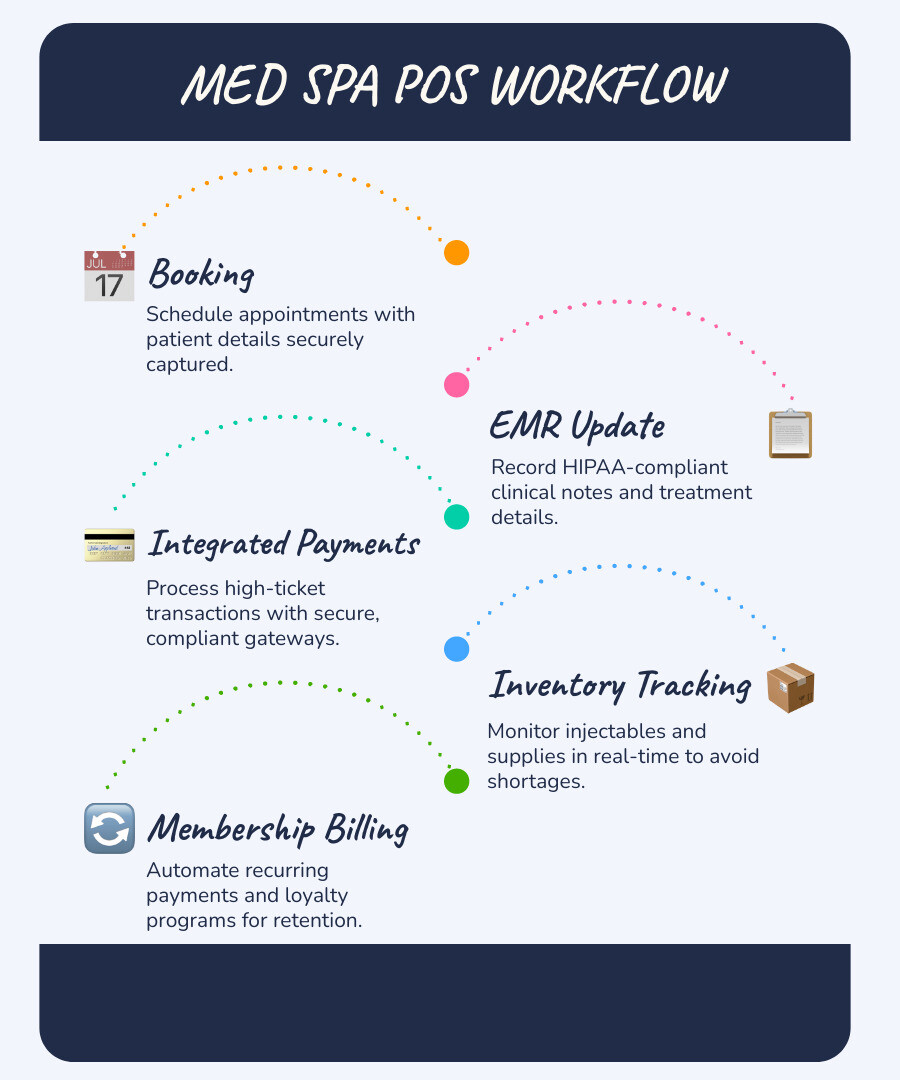
One of the biggest operational hurdles we see med spas face is fragmented data. If your patient records (EMR) don’t talk to your marketing tools (CRM) or your payment processor, you are losing money. A modern med spa POS system should allow a provider to finish a treatment, update SOAP notes, and trigger a checkout at the front desk all while the CRM sends an automated post-care follow-up. This synchronization ensures that no billable service is missed and that patient data remains secure within a single ecosystem.
Essential Features for Clinical and Financial Stability
Stability in a med spa comes from two places: clinical excellence and financial security. Your software should support both. When you are processing high-value procedures, the last thing you want is a “declined” message that results from a processor’s lack of industry knowledge.
Secure Patient Data and HIPAA Compliance
HIPAA compliance is non-negotiable. Any med spa POS system you choose must offer end-to-end encryption and detailed audit trails. A key insight from 2026 industry standards is that a payment record becomes regulated health data the moment a patient’s name is linked to a specific procedure description. This is why we emphasize the importance of Business Associate Agreements (BAAs). If your payment processor won’t sign a BAA, they are not a viable partner for a medical clinic. To ensure your hardware is as secure as your software, look into EMV terminals that protect against counterfeit card fraud at the point of sale.
Real-Time Inventory and Resource Management
Inventory in a med spa isn’t just about counting bottles of cleanser; it’s about tracking high-cost injectables down to the unit. Advanced industry-specific systems now offer AI-powered tracking that reduces charting time by up to 40% using smart templates. This allows you to monitor usage and profitability at a granular level. Furthermore, resource management tools prevent the “double-booking” of expensive laser equipment or specific treatment rooms, ensuring your overhead is always optimized.
Navigating the High-Risk Merchant Account Landscape
The most common tragedy we see in the med spa industry is the “post-approval shutdown.” This happens when a clinic signs up for an aggregated processor, is “approved” instantly, and then has its account frozen three months later when the volume hits a certain threshold.
Avoiding Post-Approval Shutdowns
Aggregated platforms use automated risk management systems. They don’t underwrite your business until after you start processing. If you suddenly process a $5,000 package, their system may flag it as “unusual” and freeze your funds for up to 180 days.
At Vector Payments, we believe in manual underwriting from day one. By choosing a dedicated merchant account, your business is vetted before you process your first dollar. This provides long-term stability and prevents the “busy season” shutdowns that can bankrupt a growing clinic. For a specialized look at how we handle these risks, visit our page on Med Spa Payment Processing.
Managing Declined Transactions and Chargebacks
When a transaction is declined, it’s often because of “risk filters” that don’t understand med spa spending patterns. Beyond that, chargebacks are a constant threat. We recommend using your med spa POS system to store before-and-after photos as evidence of service delivery. If a client disputes a charge, having a signed consent form and photographic evidence linked to the transaction record is your best defense. Additionally, implementing 3D Secure can verify transactions before they are approved, shifting the liability away from your clinic.
Maximizing Revenue Through Integrated Payment Solutions
Your med spa POS system should be a tool for growth, not just a way to collect money. By leveraging modern fintech, you can create recurring revenue streams that stabilize your cash flow.
Memberships and Treatment Packages
Memberships (often called “Beauty Banks”) are the lifeblood of modern aesthetics. An integrated POS can automate monthly billing for these programs, ensuring a steady stream of revenue even during slow months. This automation reduces the administrative burden on your front desk and increases client retention. For clinics that offer a mix of retail and medical services, understanding Beauty Salon Payment Processing can help you bridge the gap between simple retail sales and complex medical billing.
Mobile and Cloud-Based Operational Benefits
The days of being tethered to a front desk are over. Using wireless mobile terminals allows your providers to check out clients in the privacy of the treatment room. This not only improves the client experience but also allows for more personalized upselling. Cloud-based systems also give you real-time analytics across multiple locations, allowing you to monitor performance from your phone while away from the office.
Frequently Asked Questions about Med Spa Software
Why are med spas considered high-risk by processors?
Med spas are classified as high-risk due to three main factors: high average transaction values (often thousands of dollars), the sale of prepaid packages (which creates future liability), and the subjective nature of aesthetic outcomes which leads to higher-than-average chargeback rates.
How does a POS system ensure HIPAA compliance?
A HIPAA-compliant med spa POS system ensures that all Protected Health Information (PHI) is encrypted both at rest and in transit. It also requires role-based access controls, meaning a receptionist only sees the data needed for booking, while a medical director can access full clinical charts. Most importantly, the provider must sign a Business Associate Agreement (BAA).
What is the difference between a PayFac and a dedicated merchant account?
A Payment Facilitator (PayFac) bundles thousands of businesses into one master account, using automated risk tools that often lead to sudden shutdowns. A dedicated merchant account is an individual account tailored to your specific business, with underwriting performed upfront and focused on your actual business individually to ensure long-term stability.
Conclusion
The med spa POS system you choose today will determine your clinic’s ability to scale tomorrow. Don’t let your hard work be undermined by a generic payment processor that doesn’t understand the complexities of aesthetic medicine. From HIPAA-compliant charting to high-risk merchant account stability, every layer of your technology stack must be built for the unique demands of the med spa industry.
At Vector Payments, we specialize in providing the long-term stability that med spas across the country need to thrive. We offer transparent rates, 7-day support, and the peace of mind that comes from knowing your funds won’t be frozen by an algorithm.
Ready to Build on a Foundation of Stability?
Secure your med spa payment processing today with transparent rates and 7-day support.
Secure Your Med Spa Merchant Account